Explore STRAPP test options
Source:vignettes/explore_STRAPP_test_types.Rmd
explore_STRAPP_test_types.Rmd
This vignette presents the different types of STRAPP
tests that can be carried out with deepSTRAPP across the
different types of data (i.e., continuous, binary, and multinomial).
Two-tailed tests make no assumption on the direction of the
effect tested.
One-tailed tests make a hypothesis on the direction of the effect tested.
- For continuous data, the direction of the correlation is either “positive” or “negative”.
- For binary data, the rate difference between state A and state B can be either “A > B” or “B > A”.
- For multinomial data, overall Kruskal-Wallis tests are one-tailed by definition. They test for a rate difference across all states/ranges at once.
- Post hoc pairwise Dunn’s tests carried out between pairs of states/ranges can be one-tailed or two-tailed, with all configurations tested by default.
Please note that the trait data and phylogeny calibration used
in these examples are NOT valid biological data. They
were modified in order to provide results illustrating the usefulness of
deepSTRAPP.
# ------ Example 1: Continuous trait data ------ #

#### Step 1: Prepare data ####

## Load phylogeny with old time-calibration
data("Ponerinae_tree_old_calib", package = "deepSTRAPP")
## Load trait df
data("Ponerinae_trait_tip_data", package = "deepSTRAPP")

## Load BAMM diversification outputs
data("Ponerinae_BAMM_object_old_calib", package = "deepSTRAPP")
# This dataset is only available in development versions installed from GitHub.
# It is not available in CRAN versions.
# Use remotes::install_github(repo = "MaelDore/deepSTRAPP") to get the latest development version.


# Extract continuous trait data as a named vector
Ponerinae_cont_tip_data <- setNames(object = Ponerinae_trait_tip_data$fake_cont_tip_data,
                                    nm = Ponerinae_trait_tip_data$Taxa)

# This is not valid biological data. For the sake of example, we will assume this is size data.

# Reorder tip data as in phylogeny
Ponerinae_cont_tip_data <- Ponerinae_cont_tip_data[Ponerinae_tree_old_calib$tip.label]

# Run prepare_trait_data with default options
# For continuous trait, a BM model is assumed by default.
Ponerinae_trait_object <- prepare_trait_data(tip_data = Ponerinae_cont_tip_data,
                                             trait_data_type = "continuous",
                                             phylo = Ponerinae_tree_old_calib,
                                             evolutionary_model = "BM",
                                             seed = 1234) # Set seed for reproducibility


#### Step 2: Run a two-tailed test ####

# No assumption is made on the direction of the effect tested.
# The null hypothesis is that no correlation can be found between rates and trait values.
# The alternative hypothesis is that there is a correlation between rates and trait values,
# in any direction (i.e., "positive" or "negative").

# Here, we run a two-tailed STRAPP test for t = 10 Mya.
focal_time <- 10

deepSTRAPP_output_two_tailed <- run_deepSTRAPP_for_focal_time(
   # Provide ML trait estimates as a contMap
   contMap = Ponerinae_trait_object$contMap,
   ace = Ponerinae_trait_object$ace,
   tip_data = Ponerinae_cont_tip_data,
   trait_data_type = "continuous",
   BAMM_object = Ponerinae_BAMM_object_old_calib,
   focal_time = focal_time,
   # Deal with uncertainty in estimates by combining trait ML estimates
   # with all BAMM posterior samples
   uncertainty_strategy = "rates_only",
   two_tailed = TRUE, # Select a two-tailed test (Default)
   rate_type = "net_diversification",
   seed = 1234, # Set seed for reproducibility
   return_perm_data = TRUE, # Keep permutation data to be able to plot histograms of tests
   # Needed to access trait and rate data to evaluate the direction of the correlation
   extract_trait_data_melted_df = TRUE,
   extract_diversification_data_melted_df = TRUE)

## Explore output
str(deepSTRAPP_output_two_tailed, max.level = 1)

# Access deepSTRAPP results
deepSTRAPP_output_two_tailed$STRAPP_results[1:5]

# We obtain a p-value = 0.018 leading us to discard the null hypothesis (no correlation).
# The estimate is the quantile 5% of the distribution of differences in
# absolute Spearman rho-stats between observed and permuted data.
# The test is significant as the estimate is higher than zero.
# However, without plotting the rates vs. trait data, we do not know the direction of this correlation.

# Plot histogram of Spearman rank correlation test stats
plot_histogram_STRAPP_test_for_focal_time(
  deepSTRAPP_outputs = deepSTRAPP_output_two_tailed)

# The test is significant as the red line (quantile 5% = 0.066) is above the null expectation
# that Δ abs(Spearman rho-stats) = 0.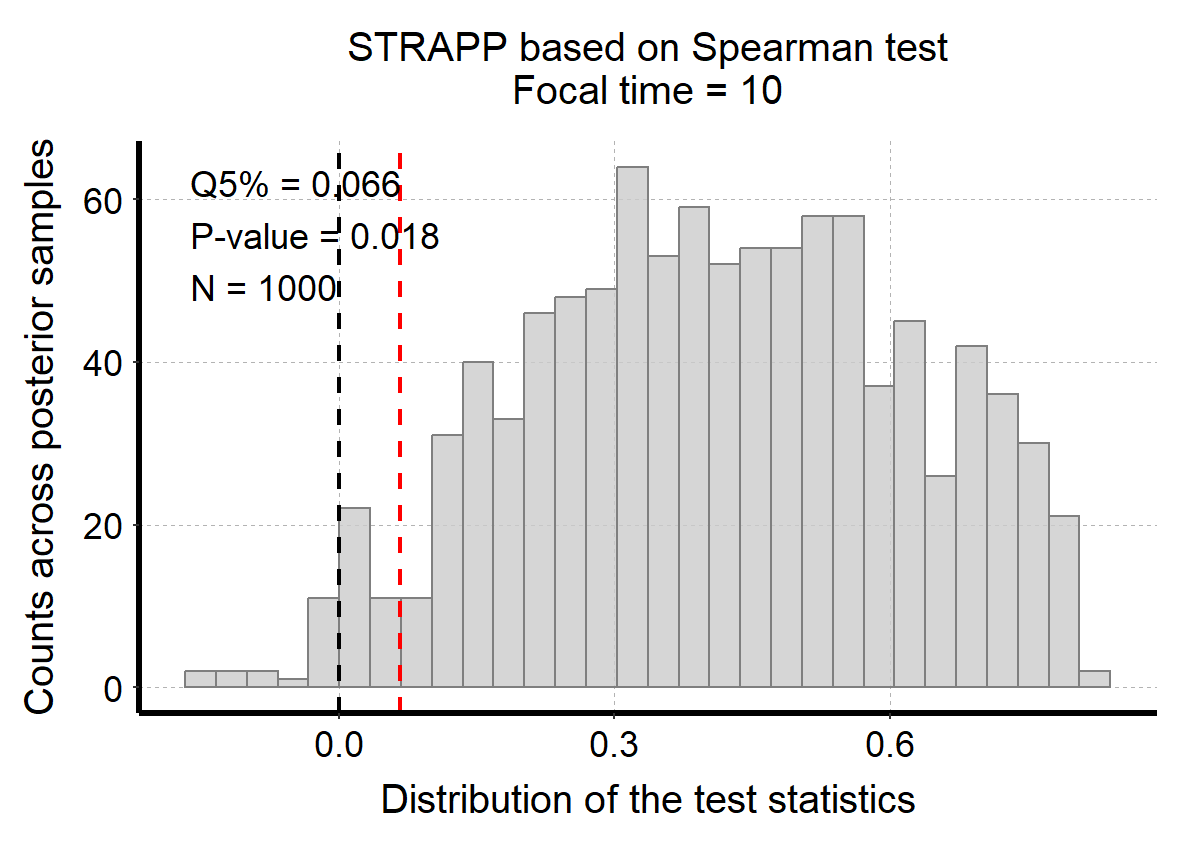
## Plot rates vs. trait values

# We can plot the mean rates vs. trait values inferred by deepSTRAPP for T = 10Mya
# to unravel the direction of the correlation detected.

?plot_rates_vs_trait_data_for_focal_time()

# Select a color scheme from lowest to highest values (i.e., small ants to large ants)
color_scale = c("darkgreen", "limegreen", "orange", "red")

# Plot mean rates vs. traits aggregated across all BAMM posterior samples
plot_rates_vs_trait_data_for_focal_time(deepSTRAPP_outputs = deepSTRAPP_output_two_tailed,
                                        color_scale = color_scale)

# The plot indicates that mean rates are globally negatively correlated with mean trait values as
# "small" ants exhibit higher mean rates than "large" ants for T = 10 Mya.
# The plot also displays summary statistics for the STRAPP test associated with the data shown:
#   * An observed statistic computed across the mean rates and trait values shown on the plot.
#     Here, rho obs = -0.86, indicates a negative correlation.
#     This is not the statistic of the STRAPP test itself, which is conducted across all BAMM posterior samples.
#   * The quantile of null statistic distribution at the significance threshold used to define test significance.
#     The test will be considered significant (i.e., the null hypothesis is rejected)
#     if this value is higher than zero, as shown on the histogram above.
#     Here, Q5% = 0.066, so the test is significant (according to this significance threshold).
#   * The p-value of the associated STRAPP test. Here, p = 0.018.

# We could have directly tested for this hypothesis with a one-tailed test (See Step 3 below).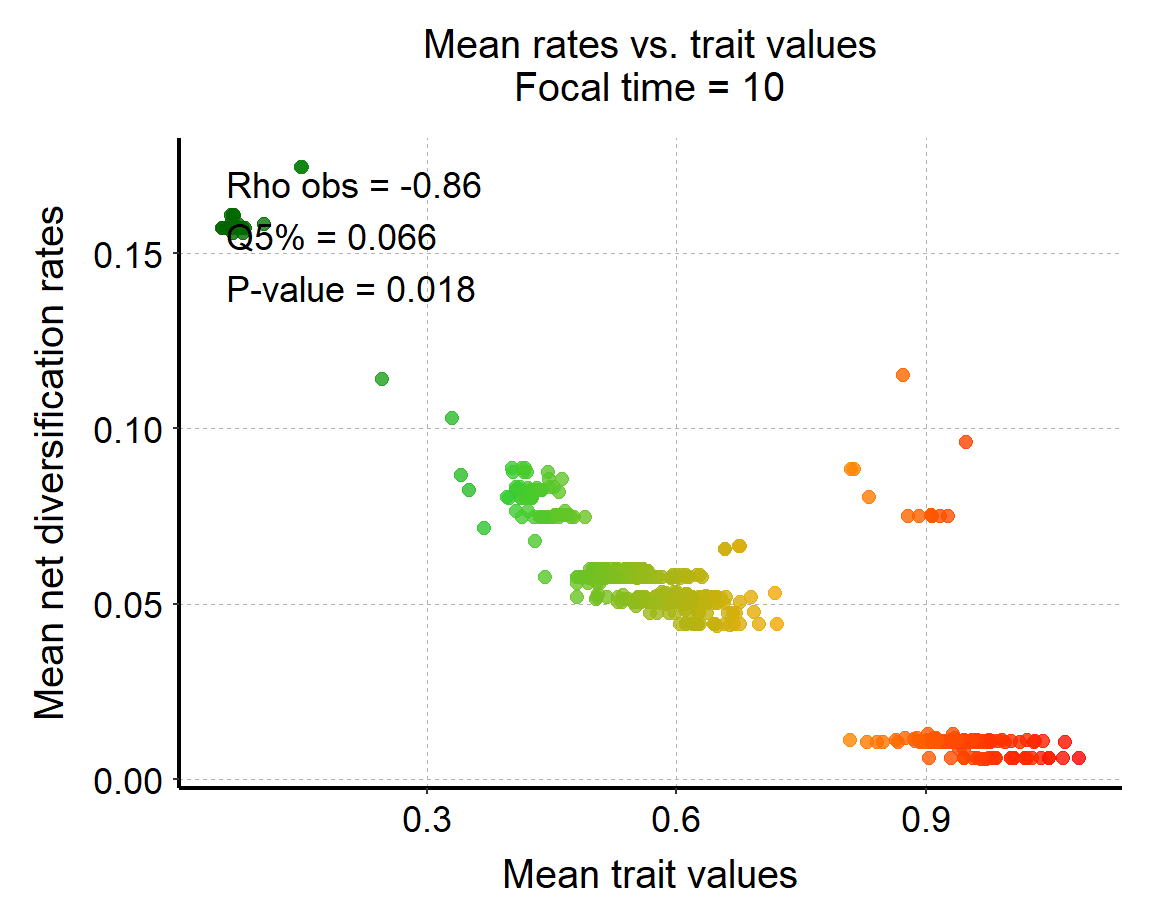
#### Step 3: Run a one-tailed test ####

# Here, we make an assumption on the direction of the effect tested.
# The null hypothesis is that there is a positive or no correlation between rates and trait values.
# The alternative hypothesis is that there is a negative correlation between rates and trait values.

# We run a one-tailed STRAPP test for t = 10 Mya.
focal_time <- 10

deepSTRAPP_output_one_tailed <- run_deepSTRAPP_for_focal_time(
   contMap = Ponerinae_trait_object$contMap,
   ace = Ponerinae_trait_object$ace,
   tip_data = Ponerinae_cont_tip_data,
   trait_data_type = "continuous",
   BAMM_object = Ponerinae_BAMM_object_old_calib,
   focal_time = focal_time,
   uncertainty_strategy = "rates_only",
   two_tailed = FALSE, # Select a one-tailed test
   one_tailed_hypothesis = "negative", # We select a "negative" correlation as the alternative hypothesis
   rate_type = "net_diversification",
   seed = 1234, # Set seed for reproducibility
   return_perm_data = TRUE) # Keep permutation data to be able to plot histograms of tests

## Explore output
str(deepSTRAPP_output_one_tailed, max.level = 1)

# Access deepSTRAPP results
deepSTRAPP_output_one_tailed$STRAPP_results[1:5]

# We obtain a p-value = 0.009 leading us to discard the null hypothesis
# (no correlation or positive correlation).
# Thus, the alternative hypothesis (negative correlation) is supported by the test.
# The estimate is the quantile 95% of the distribution of differences in Spearman rho-stats
# between observed and permuted data.
# The test is significant as the estimate is lower than zero.

# Plot histogram of Spearman rank correlation test stats
plot_histogram_STRAPP_test_for_focal_time(
  deepSTRAPP_outputs = deepSTRAPP_output_one_tailed)

# The test is significant as the red line (quantile 95% = -0.147) is below the null expectation
# that Δ Spearman rho stat = 0.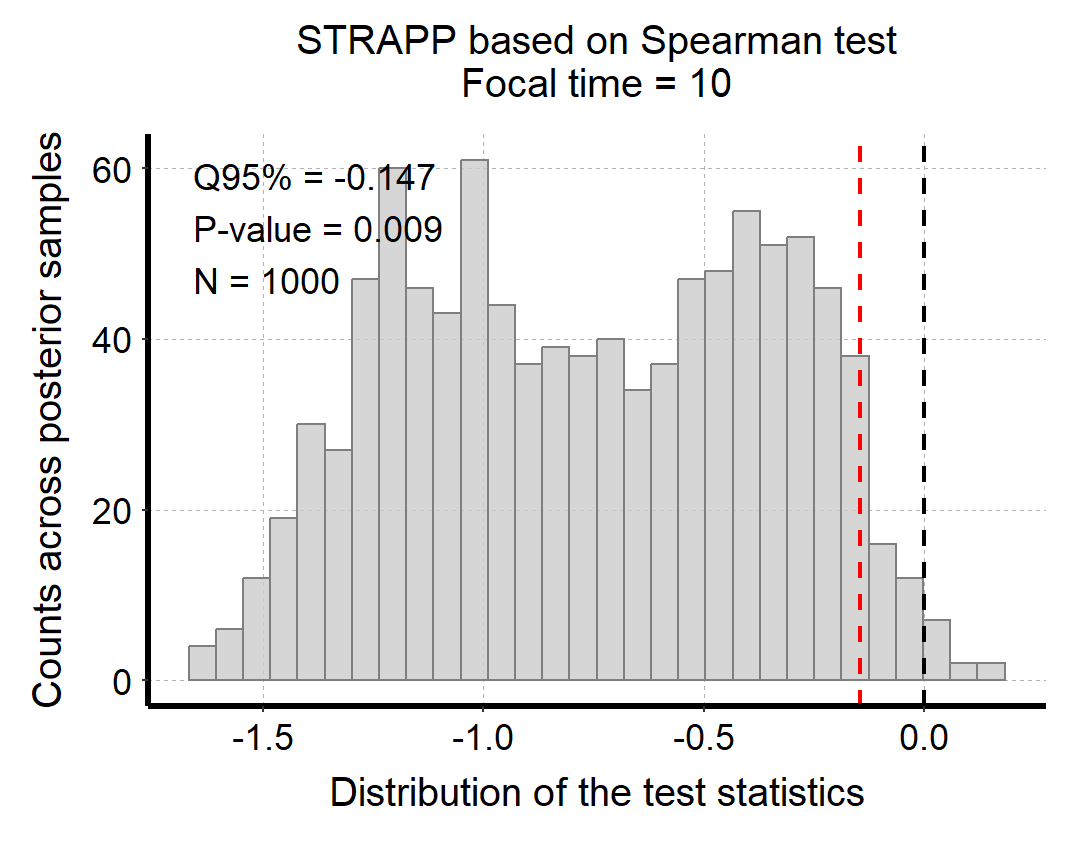
# ------ Example 2: Categorical binary trait data ------ #

#### Step 1: Prepare data ####

## Load phylogeny with old time-calibration
data("Ponerinae_tree_old_calib", package = "deepSTRAPP")
## Load trait df
data("Ponerinae_trait_tip_data", package = "deepSTRAPP")

## Load BAMM diversification outputs
data("Ponerinae_BAMM_object_old_calib", package = "deepSTRAPP")
# This dataset is only available in development versions installed from GitHub.
# It is not available in CRAN versions.
# Use remotes::install_github(repo = "MaelDore/deepSTRAPP") to get the latest development version.


# Extract categorical (2-levels) trait data as a named vector
Ponerinae_cat_2lvl_tip_data <- setNames(object = Ponerinae_trait_tip_data$fake_cat_2lvl_tip_data,
                                    nm = Ponerinae_trait_tip_data$Taxa)
# Reorder tip data as in phylogeny
Ponerinae_cat_2lvl_tip_data <- Ponerinae_cat_2lvl_tip_data[Ponerinae_tree_old_calib$tip.label]

# Select color scheme for states
colors_per_states <- c("darkblue", "lightblue")
names(colors_per_states) <- c("large", "small")

# Run prepare_trait_data with default options
Ponerinae_trait_object <- prepare_trait_data(tip_data = Ponerinae_cat_2lvl_tip_data,
                                             trait_data_type = "categorical",
                                             phylo = Ponerinae_tree_old_calib,
                                             evolutionary_model = "ARD", # Select an All-Rates-Different model
                                             colors_per_states = colors_per_states,
                                             nb_simulations = 100,
                                             seed = 1234) # Set seed for reproducibility
# Load directly output to save time
data(Ponerinae_cat_2lvl_data_old_calib, package = "deepSTRAPP")
Ponerinae_trait_object <- Ponerinae_cat_2lvl_data_old_calib


#### Step 2: Run a two-tailed test ####

# No assumption is made about which states exhibit the highest rates.
# The null hypothesis is that there is no difference in rates between the two states.
# The alternative hypothesis is that there is a difference in rates between the two states,
# in any direction (i.e., "small > large" or "large > small").

# Here, we run a two-tailed STRAPP test for t = 10 Mya.
focal_time <- 10

deepSTRAPP_output_two_tailed <- run_deepSTRAPP_for_focal_time(
   densityMaps = Ponerinae_trait_object$densityMaps,
   ace = Ponerinae_trait_object$ace,
   tip_data = Ponerinae_cat_2lvl_tip_data,
   trait_data_type = "categorical",
   BAMM_object = Ponerinae_BAMM_object_old_calib,
   focal_time = focal_time,
   two_tailed = TRUE, # Select a two-tailed test (Default)
   rate_type = "net_diversification",
   uncertainty_strategy = "rates_only",
   seed = 1234, # Set seed for reproducibility
   return_perm_data = TRUE, # Keep permutation data to be able to plot histograms of tests
   # Needed to access traits and rates data to evaluate the direction of the correlation
   extract_trait_data_melted_df = TRUE,
   extract_diversification_data_melted_df = TRUE)

## Explore output
str(deepSTRAPP_output_two_tailed, max.level = 1)

# Access deepSTRAPP results
deepSTRAPP_output_two_tailed$STRAPP_results[1:5]

# We obtain a p-value = 0.047 leading us to (barely) discard the null hypothesis (no differences).
# The estimate is the quantile 5% of the distribution of differences
# in absolute Mann-Whitney-Wilcoxon U-stats between observed and permuted data.
# The test is significant as the estimate is higher than zero.
# However, without plotting the rates vs. states, we do not know the direction of this difference.

# Plot histogram of Mann-Whitney-Wilcoxon test stats
plot_histogram_STRAPP_test_for_focal_time(
  deepSTRAPP_outputs = deepSTRAPP_output_two_tailed)

# The test is significant as the red line (quantile 5% = 176.45) is above the null expectation
# that Δ abs(Mann-Whitney-Wilcoxon U-stats) = 0.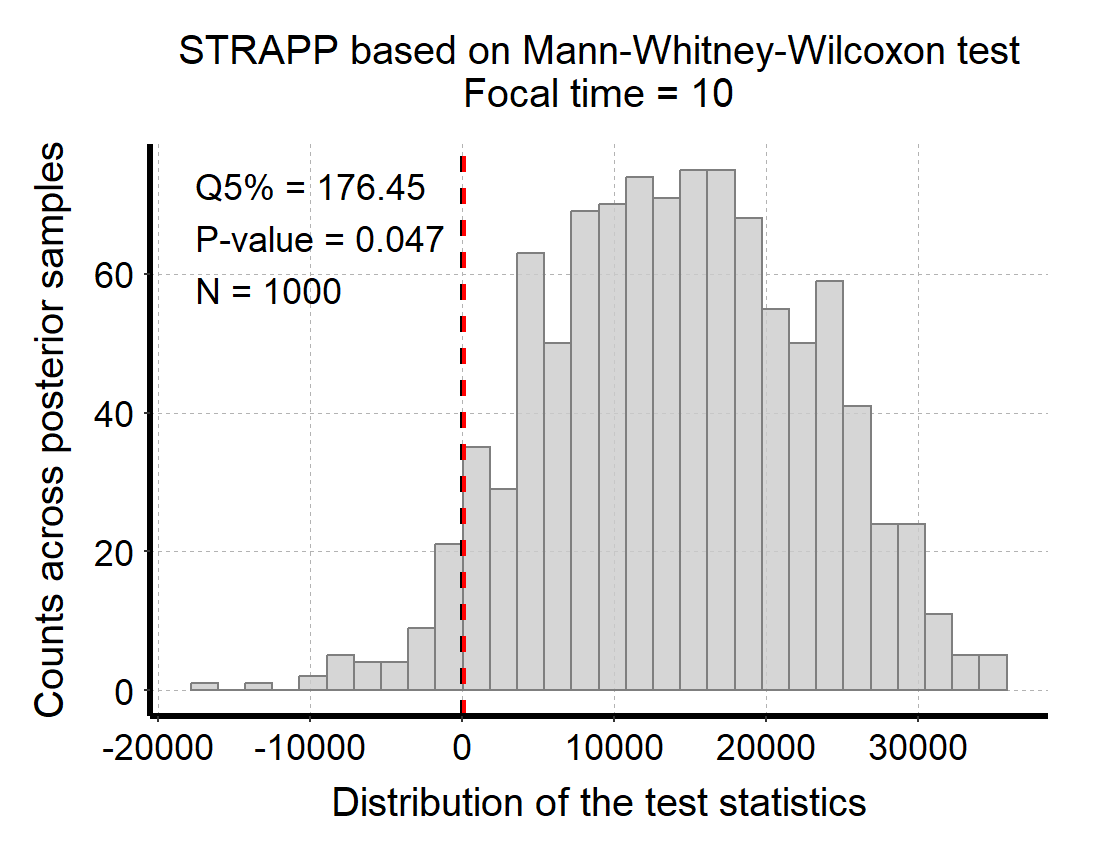
## Plot rates vs. trait values

# We can plot the mean rates vs. states inferred by deepSTRAPP for T = 10Mya
# to unravel the direction of the difference detected.

?plot_rates_vs_trait_data_for_focal_time()

# Plot mean rates vs. trait states aggregated across all BAMM posterior samples
plot_rates_vs_trait_data_for_focal_time(deepSTRAPP_outputs = deepSTRAPP_output_two_tailed,
                                        colors_per_levels = colors_per_states)

# The plot highlights that "small" ants exhibited higher rates than "large" ants for T = 10 Mya.
# The plot also displays summary statistics for the STRAPP test associated with the data shown:
#   * An observed statistic computed across the mean rates and trait states shown on the plot.
#     Here, the very low U-stats obs = -38713, indicates the first group "large" ants have lower rates than "small" ants.
#     This is not the statistic of the STRAPP test itself, which is conducted across all BAMM posterior samples.
#   * The quantile of null statistic distribution at the significance threshold used to define test significance.
#     The test will be considered significant (i.e., the null hypothesis is rejected)
#     if this value is higher than zero, as shown on the histogram above.
#     Here, Q5% = 176.45, so the test is significant (according to this significance threshold).
#   * The p-value of the associated STRAPP test. Here, p = 0.047.

# We could have directly tested for this hypothesis (i.e., "small" > "large") with a one-tailed test (See Step 3 below).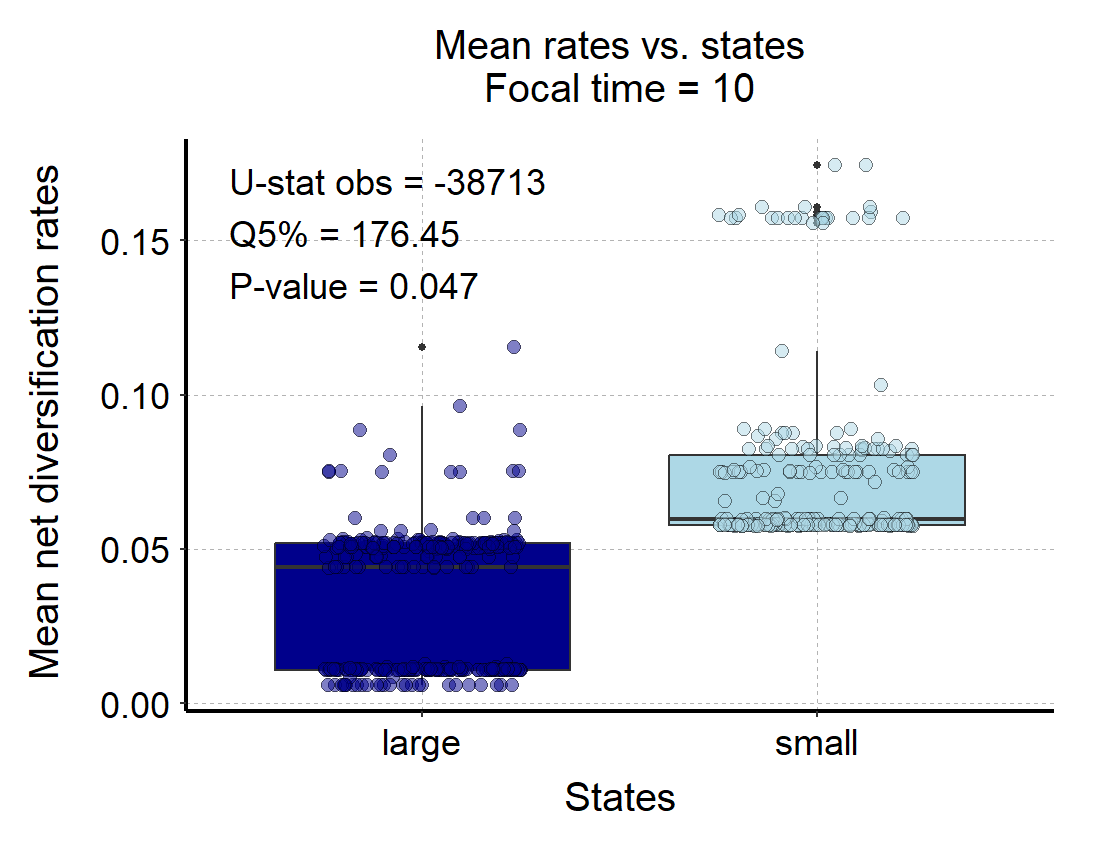
#### Step 3: Run a one-tailed test ####

# Here, we make an assumption on the direction of the effect tested.
# The null hypothesis is that diversification rates are lower or equal
# for "small" ants compared to "large" ants.
# The alternative hypothesis is that diversification rates are higher
# for "small" ants than "large" ants.

# We run a one-tailed STRAPP test for t = 10 Mya.
focal_time <- 10

deepSTRAPP_output_one_tailed <- run_deepSTRAPP_for_focal_time(
   densityMaps = Ponerinae_trait_object$densityMaps,
   ace = Ponerinae_trait_object$ace,
   tip_data = Ponerinae_cat_2lvl_tip_data,
   trait_data_type = "categorical",
   BAMM_object = Ponerinae_BAMM_object_old_calib,
   focal_time = focal_time,
   uncertainty_strategy = "rates_only",
   two_tailed = FALSE, # Select a one-tailed test
   one_tailed_hypothesis = "small > large", # We select "small > large" as the alternative hypothesis
   rate_type = "net_diversification",
   seed = 1234, # Set seed for reproducibility
   return_perm_data = TRUE) # Keep permutation data to be able to plot histograms of tests

## Explore output
str(deepSTRAPP_output_one_tailed, max.level = 1)

# Access deepSTRAPP results
deepSTRAPP_output_one_tailed$STRAPP_results[1:5]

# We obtain a p-value = 0.020 leading us to discard the null hypothesis ("small <= large").
# Thus, the alternative hypothesis ("small > large") is supported by the test.
# The estimate is the quantile 5% of the distribution of differences in Mann-Whitney-Wilcoxon U-stats
# between observed and permuted data
# The test is significant as the estimate is higher than zero.

# Plot histogram of Mann-Whitney-Wilcoxon test stats
plot_histogram_STRAPP_test_for_focal_time(
  deepSTRAPP_outputs = deepSTRAPP_output_one_tailed)

# The test is significant as the red line (quantile 5% = 3335.4) is above the null expectation
# that Δ Mann-Whitney-Wilcoxon U-stats = 0.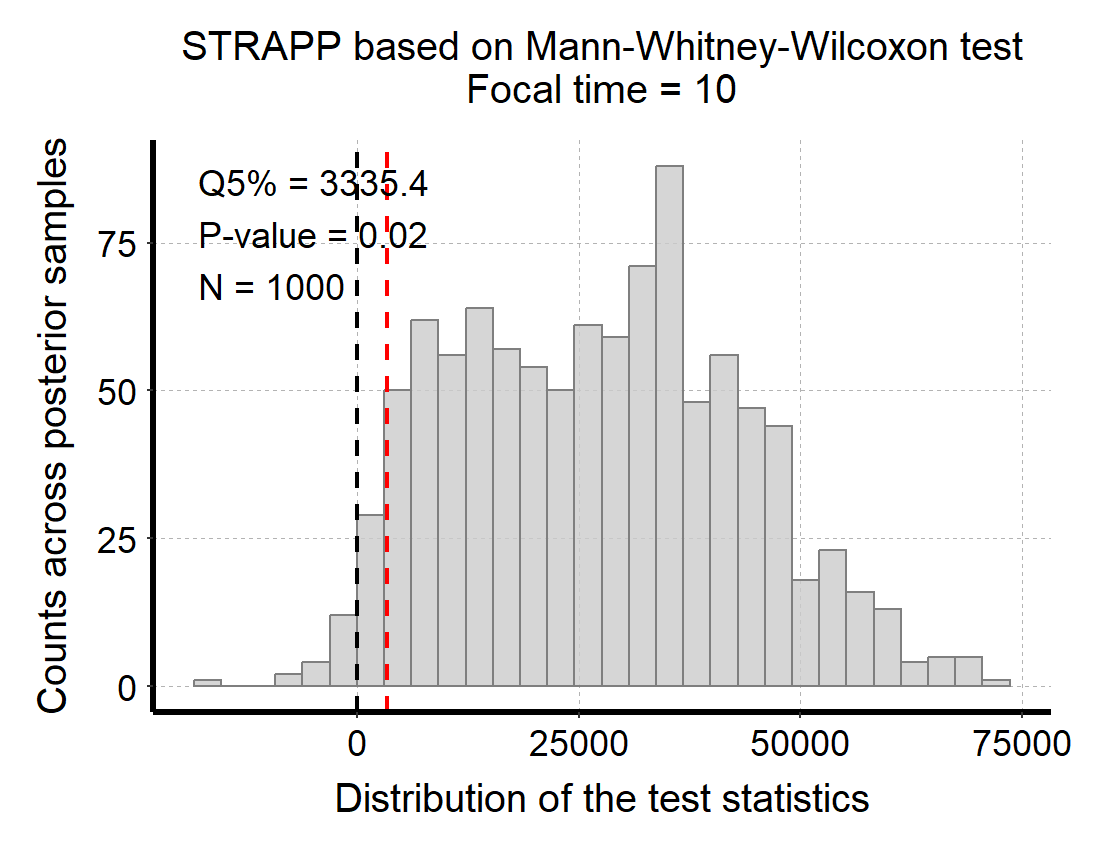
# ------ Example 3: Categorical multinomial (3-levels) trait data ------ #

#### Step 1: Prepare data ####

## Load phylogeny with old time-calibration
data("Ponerinae_tree_old_calib", package = "deepSTRAPP")
## Load trait df
data("Ponerinae_trait_tip_data", package = "deepSTRAPP")

## Load BAMM diversification outputs
data("Ponerinae_BAMM_object_old_calib", package = "deepSTRAPP")
# This dataset is only available in development versions installed from GitHub.
# It is not available in CRAN versions.
# Use remotes::install_github(repo = "MaelDore/deepSTRAPP") to get the latest development version.


# Extract categorical (3-levels) data as a named vector
Ponerinae_cat_3lvl_tip_data <- setNames(object = Ponerinae_trait_tip_data$fake_cat_3lvl_tip_data,
                                    nm = Ponerinae_trait_tip_data$Taxa)
# Reorder tip data as in phylogeny
Ponerinae_cat_3lvl_tip_data <- Ponerinae_cat_3lvl_tip_data[Ponerinae_tree_old_calib$tip.label]

## Select color scheme for states (i.e., habitats)
colors_per_states <- c("forestgreen", "sienna", "goldenrod")
names(colors_per_states) <- c("arboreal", "subterranean", "terricolous")

# Run prepare_trait_data with default options
Ponerinae_trait_object <- prepare_trait_data(tip_data = Ponerinae_cat_3lvl_tip_data,
                                             trait_data_type = "categorical",
                                             phylo = Ponerinae_tree_old_calib,
                                             evolutionary_model = "ARD", # Select an All-Rates-Different model
                                             colors_per_states = colors_per_states,
                                             nb_simulations = 100,
                                             seed = 1234) # Set seed for reproducibility
# Load directly output to save time
data(Ponerinae_cat_3lvl_data_old_calib, package = "deepSTRAPP")
Ponerinae_trait_object <- Ponerinae_cat_3lvl_data_old_calib

#### Step 2: Run the overall Kruskal-Wallis test ####

# For multinomial data (i.e., with more than two states/ranges), the overall test
# is by definition a one-tailed Kruskal-Wallis test for rate differences across all states/ranges.
# There is no two-tailed version of this test, thus deepSTRAPP assumes a one-tailed test by default.
# The null hypothesis is that there is no difference in rates across all states/ranges.
# The alternative hypothesis is that there is at least one pair of states/ranges
# with differences in diversification rates.

# To test for differences between pairs of states/ranges, you need to run post hoc pairwise tests.
# These Dunn's tests can be one-tailed or two-tailed depending on the null hypotheses stated.
# See the next Steps 3 & 4 for post hoc pairwise tests.

# Here, we run an overall STRAPP test for t = 10 Mya.
focal_time <- 10

deepSTRAPP_output_overall <- run_deepSTRAPP_for_focal_time(
   densityMaps = Ponerinae_trait_object$densityMaps,
   ace = Ponerinae_trait_object$ace,
   tip_data = Ponerinae_cat_3lvl_tip_data,
   trait_data_type = "categorical",
   BAMM_object = Ponerinae_BAMM_object_old_calib,
   focal_time = focal_time,
   uncertainty_strategy = "rates_only",
   alpha = 0.10, # Adjust the significance threshold
   posthoc_pairwise_tests = FALSE, # To run the overall test
   rate_type = "net_diversification",
   seed = 1234, # Set seed for reproducibility
   return_perm_data = TRUE, # Keep permutation data to be able to plot histograms of tests
   # Needed to access traits and rates data to evaluate the direction of the correlation
   extract_trait_data_melted_df = TRUE,
   extract_diversification_data_melted_df = TRUE)

## Explore output
str(deepSTRAPP_output_overall, max.level = 1)

# Access deepSTRAPP results
deepSTRAPP_output_overall$STRAPP_results[1:5]

# We obtain a p-value = 0.083 leading us to discard the null hypothesis (no differences).
# The estimate is the quantile 10% of the distribution of differences
# in Kruskal-Wallis H-stats between observed and permuted data.
# The test is significant as the estimate is higher than zero.
# However, without plotting the rates vs. states, or running post hoc pairwise tests,
# we do not know which pairs of states exhibit differences.

# Plot histogram of Kruskal-Wallis one-way ANOVA test stats
plot_histogram_STRAPP_test_for_focal_time(
  deepSTRAPP_outputs = deepSTRAPP_output_overall)

# The test is significant as the red line (quantile 10% = 5.606) is above the null expectation
# that Δ Kruskal-Wallis H-stats = 0.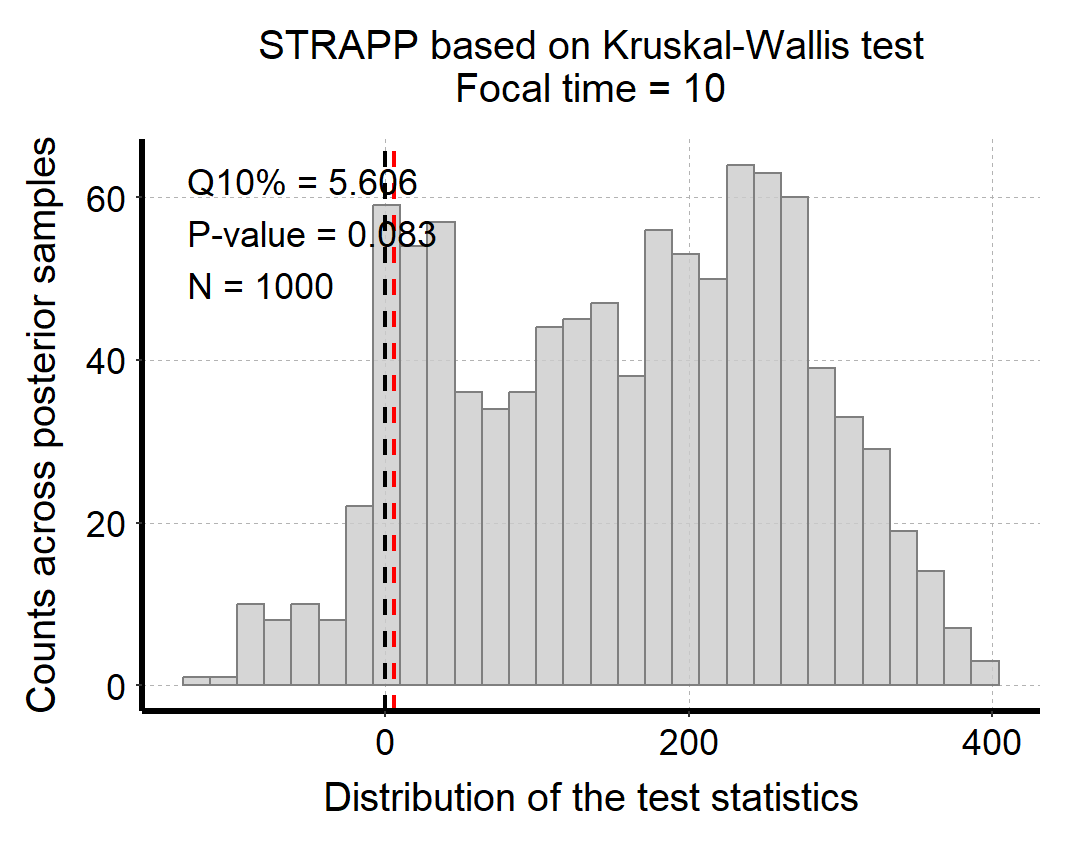
## Plot rates vs. trait values

# We can plot the mean rates vs. states inferred by deepSTRAPP for T = 10Mya
# to unravel the direction of the differences detected.

?plot_rates_vs_trait_data_for_focal_time()

# Plot mean rates vs. trait states aggregated across all BAMM posterior samples
plot_rates_vs_trait_data_for_focal_time(deepSTRAPP_outputs = deepSTRAPP_output_overall,
                                        colors_per_levels = colors_per_states)

# The plot indicates that net diversification rates are higher in "terricolous" ants,
# than "subterranean" ants, and lower in "arboreal" ants, for T = 10 Mya.
# The plot also displays summary statistics for the STRAPP test associated with the data shown:
#   * An observed statistic computed across the mean rates and trait states (i.e., habitats) shown on the plot.
#     Here, the high H-stat obs = 374.82 indicates there is a difference in rates between states.
#     Please note that this is not the statistic of the STRAPP test itself,
#     which is conducted across all BAMM posterior samples.
#   * The quantile of null statistic distribution at the significance threshold used to define test significance.
#     The test will be considered significant (i.e., the null hypothesis is rejected)
#     if this value is higher than zero, as shown on the histogram above.
#     Here, Q10% = 5.606, so the test is significant (according to this significance threshold),
#     meaning we detected differences between habitats overall.
#   * The p-value of the associated STRAPP test. Here, p = 0.083.

# We can explore those potential differences with post hoc pairwise tests,
# with either one-tailed or two-tailed tests (See Steps 3 & 4 below).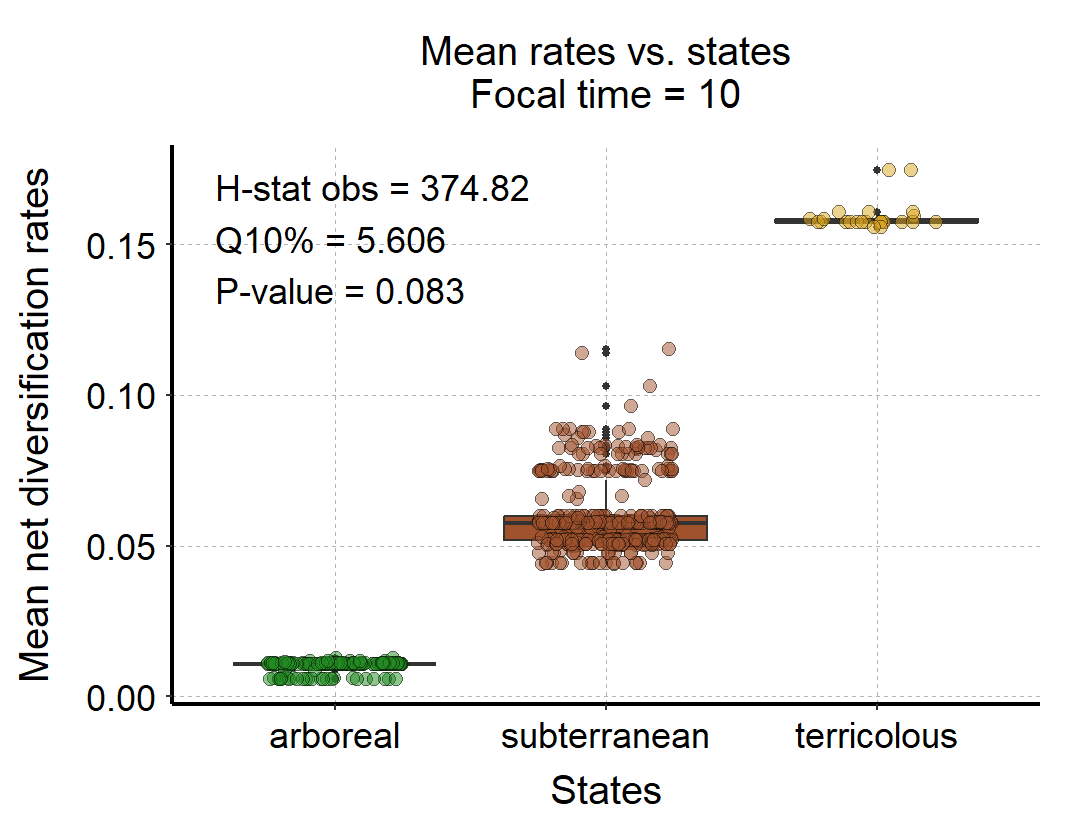
#### Step 3: Run all post hoc Dunn's two-tailed tests ####

# Post hoc tests are pairwise tests for differences between pairs of states/ranges.
# They can be two-tailed, without assumption regarding which states exhibit higher rates than the others,
# or they can be one-tailed, with assumption on which states exhibit higher rates within each pair.

# deepSTRAPP runs post hoc pairwise tests across all pairs of states.
# You can choose which type of tests (i.e., "two-tailed" or "one-tailed") to run.
# Here, the two-tailed version is presented. See Step 4 for the one-tailed version.

# In the two-tailed tests, the null hypothesis for each pair is that there is
# no difference in rates between the two states.
# The alternative hypothesis is that there is a difference in rates between the two states,
# in any direction (e.g., "arboreal > terricolous" or "terricolous > arboreal").

# You can also select a method to adjust p-values for multiple testing.
# See stats::p.adjust() for the available methods.
# Here, we select none.

# We run a two-tailed STRAPP test for t = 10 Mya.
focal_time <- 10

deepSTRAPP_output_two_tailed <- run_deepSTRAPP_for_focal_time(
   densityMaps = Ponerinae_trait_object$densityMaps,
   ace = Ponerinae_trait_object$ace,
   tip_data = Ponerinae_cat_3lvl_tip_data,
   trait_data_type = "categorical",
   BAMM_object = Ponerinae_BAMM_object_old_calib,
   focal_time = focal_time,
   uncertainty_strategy = "rates_only",
   two_tailed = TRUE, # Select two-tailed tests for the post hoc tests (Default)
   posthoc_pairwise_tests = TRUE, # Ask for post hoc tests to be carried out
   rate_type = "net_diversification",
   seed = 1234, # Set seed for reproducibility
   return_perm_data = TRUE) # Keep permutation data to be able to plot histograms of tests

## Explore output
str(deepSTRAPP_output_two_tailed, max.level = 2)

# Access deepSTRAPP results for post hoc tests
deepSTRAPP_output_two_tailed$STRAPP_results$posthoc_pairwise_tests$summary_df

# We obtain a p-value for each pair of states. Here there are 3 possible pairs.
# Only the pair "arboreal != terricolous" yields a significant result.
# For this pair, we obtain a p-value = 0.030 leading us to discard the null hypothesis (no differences).
# The estimate is the quantile 5% of the distribution of differences
# in absolute Dunn's Z-stats between observed and permuted data.
# The test is significant as the estimate is higher than zero (Q5% = 0.532).
# However, without plotting the rates vs. states, we would not have known the direction of this difference.

# Plot histogram of all post hoc two-tailed test stats
plot_histogram_STRAPP_test_for_focal_time(
  deepSTRAPP_outputs = deepSTRAPP_output_two_tailed,
  plot_posthoc_tests = TRUE)

# Only the test for the pair "arboreal != terricolous" is significant as the red line
# (quantile 5% = 0.532) is above the null expectation that Δ Dunn's Z-stats = 0.
# The conclusion is that it is the difference in rates between "arboreal" ants
# and "terricolous" ants that drives the differences in rates recorded overall
# with the Kruskal-Wallis test.
# Yet, with this test only, we do not know which state has the higher rates
# We can look at the plot of rates vs. states above (See Step 2),
# but we can also test directly for the two hypotheses (i.e., ("arboreal" > "terricolous")
# or ("terricolous" > "arboreal") using one-tailed tests.
# See Step 4 below for the one-tailed tests.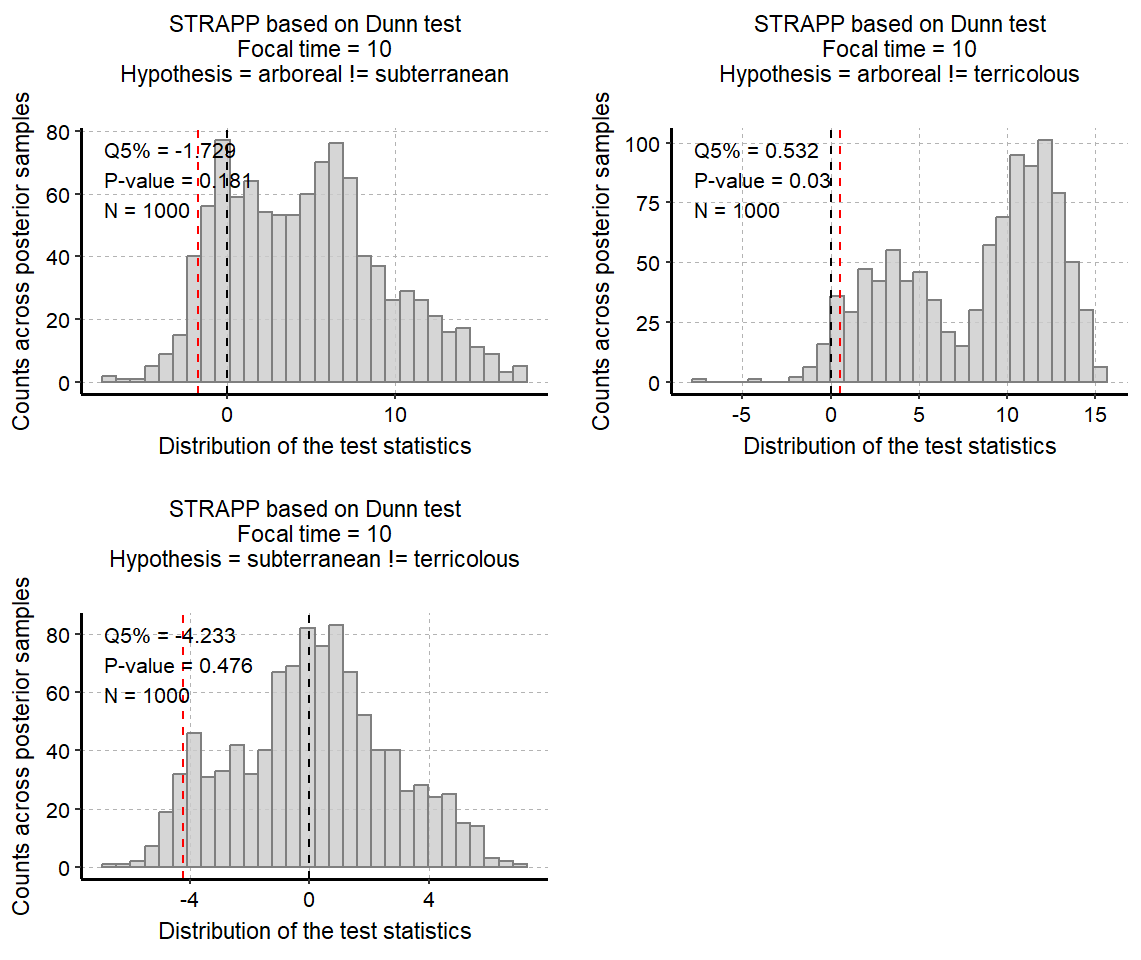
#### Step 4: Run all post hoc Dunn's one-tailed tests ####

# Here, we make assumptions on the direction of the effects tested.
# We conduct all possible one-tailed tests across pairs of states.
# Thus, for three pairs, we conduct six tests, one for each possible alternative hypothesis
# (i.e., "A" > "B" and "B" > "A").

# We run a one-tailed STRAPP test for t = 10 Mya.
focal_time <- 10

deepSTRAPP_output_one_tailed <- run_deepSTRAPP_for_focal_time(
   densityMaps = Ponerinae_trait_object$densityMaps,
   ace = Ponerinae_trait_object$ace,
   tip_data = Ponerinae_cat_3lvl_tip_data,
   trait_data_type = "categorical",
   BAMM_object = Ponerinae_BAMM_object_old_calib,
   focal_time = focal_time,
   uncertainty_strategy = "rates_only",
   two_tailed = FALSE, # Select one-tailed tests for the post hoc tests
   posthoc_pairwise_tests = TRUE, # Ask for post hoc tests to be carried out
   rate_type = "net_diversification",
   seed = 1234, # Set seed for reproducibility
   return_perm_data = TRUE) # Keep permutation data to be able to plot histograms of tests

## Explore output
str(deepSTRAPP_output_one_tailed, max.level = 2)

# Access deepSTRAPP results for post hoc tests
deepSTRAPP_output_one_tailed$STRAPP_results$posthoc_pairwise_tests$summary_df

# We obtain a p-value for each pair of states in each direction.
# Here there are 3 possible pairs = 6 one-tailed tests.
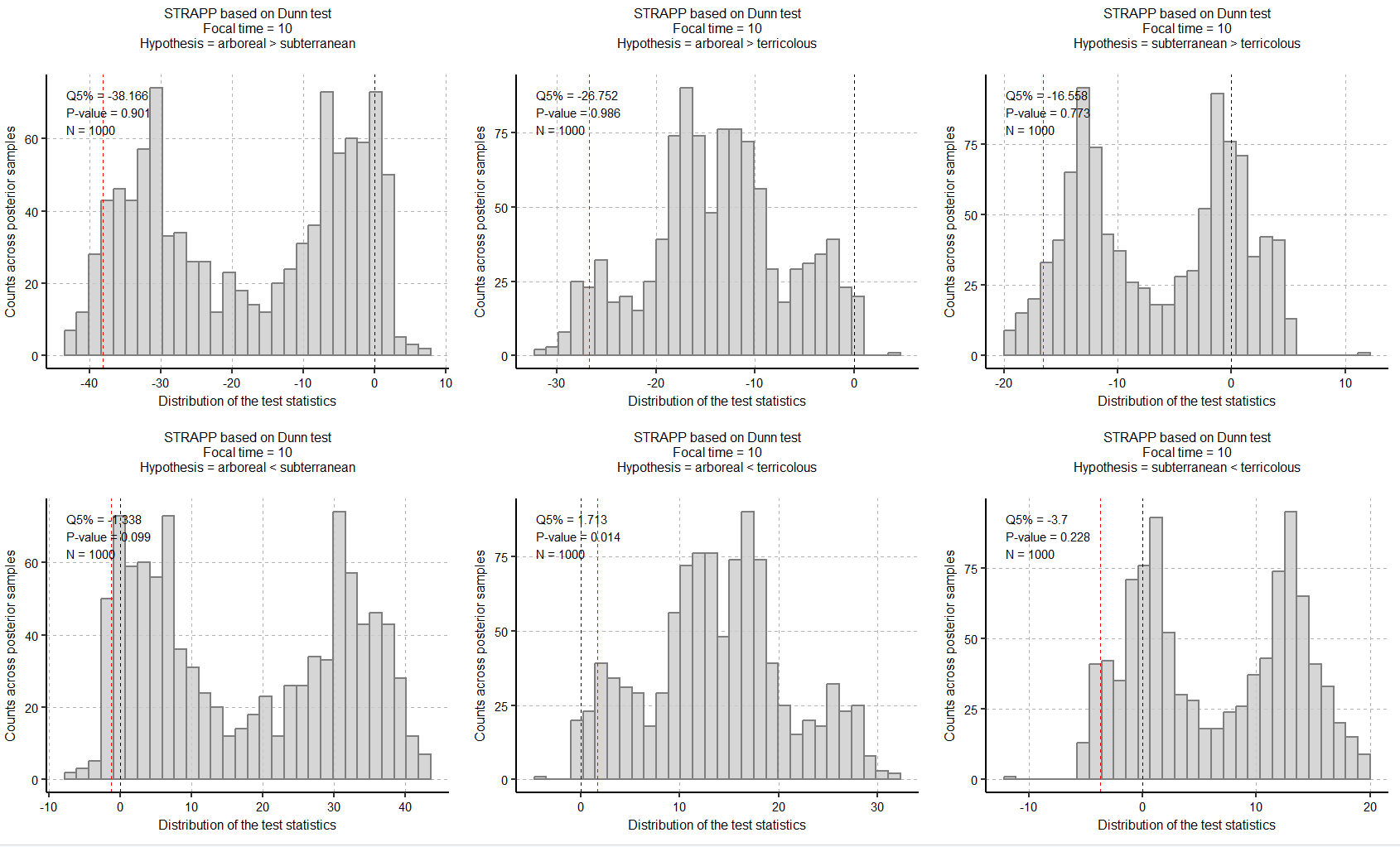
# Only the alternative hypothesis "arboreal < terricolous" yields a significant result.
# For this test, we obtain a p-value = 0.014 leading us to discard the null hypothesis that
# "arboreal" ants have equivalent or higher rates than "terricolous" ants.
# The estimate is the quantile 5% of the distribution of differences
# in Dunn's Z-stats between observed and permuted data.
# The test is significant as the estimate is higher than zero (Q5% = 1.713).
# We can conclude that our data support the idea that "arboreal" ants
# have lower diversification rates than "terricolous" ants.

# Plot histogram of all post hoc one-tailed test stats
plot_histogram_STRAPP_test_for_focal_time(
  deepSTRAPP_outputs = deepSTRAPP_output_one_tailed,
  plot_posthoc_tests = TRUE)

# Only the test for the alternative hypothesis "arboreal < terricolous" is significant as the red line
# (quantile 5% = 1.713) is above the null expectation that Δ Dunn's Z-stats = 0.
# The conclusion is that higher rates in "terricolous" ants vs. lower rates in "arboreal" ants
# are driving the differences in rates recorded overall with the Kruskal-Wallis test.