Extract most likely trait data mapped on a phylogeny at a given time in the past
Source:R/extract_most_likely_trait_values_for_focal_time.R
extract_most_likely_trait_values_for_focal_time.RdExtracts the most likely trait values/states/ranges found along branches
at a specific time in the past (i.e. the focal_time).
Optionally, the function can update the mapped phylogeny (contMap or densityMaps)
such as branches overlapping the focal_time are shortened to the focal_time,
and the trait mapping for the cut off branches are removed
by updating the $tree$maps and $tree$mapped.edge elements.
Usage
extract_most_likely_trait_values_for_focal_time(
  contMap = NULL,
  contMaps = NULL,
  densityMaps = NULL,
  simmaps = NULL,
  ace = NULL,
  tip_data = NULL,
  trait_data_type,
  focal_time,
  update_Map = FALSE,
  keep_tip_labels = TRUE
)
Arguments
- contMap
For continuous trait data. Object of class
"contMap", typically generated withprepare_trait_data()orphytools::contMap(), that contains a phylogenetic tree and associated continuous trait mapping, representing interpolated ML estimates of ancestral trait values. The phylogenetic tree must be rooted and fully resolved/dichotomous, but it does not need to be ultrametric (it can include fossils).- contMaps
For continuous trait data. List of objects of class
"contMap", typically generated withprepare_trait_data(), each containing a phylogenetic tree and associated continuous trait mapping that represents an independent evolutionary history of ancestral trait evolution, conditioned on observed trait data and model fit (i.e., stochastic maps).- densityMaps
For categorical trait or biogeographic data. List of objects of class
"densityMap", typically generated withprepare_trait_data(), that contains a phylogenetic tree and associated posterior probability of being in a given state/range along branches. Each object (i.e.,densityMap) corresponds to a state/range. The phylogenetic tree must be rooted and fully resolved/dichotomous, but it does not need to be ultrametric (it can include fossils).- simmaps
For categorical trait or biogeographic data. List of objects of classes
"phylo"and"simmap", typically generated withprepare_trait_data()orphytools::make.simmap(), that represent discrete character/geographic evolutionary history (i.e., transitions in character states/geographic ranges) mapped along branches.- ace
(Optional) Ancestral Character Estimates (ACE) at the internal nodes. Obtained with
prepare_trait_data()as output in the$aceslot.For continuous trait data: Named numeric vector typically generated with
phytools::fastAnc(),phytools::anc.ML(), orape::ace(). Names are nodes_ID of the internal nodes. Values are ACE of the trait.For categorical trait or biogeographic data: Matrix that records the posterior probabilities of ancestral states/ranges. Rows are internal nodes_ID. Columns are states/ranges. Values are posterior probabilities of each state per node. Needed in all cases to provide accurate estimates of trait values.
- tip_data
(Optional) Named vector of tip values of the trait.
For continuous trait data: Named numeric vector of trait values.
For categorical trait or biogeographic data: Character string vector of states/ranges Names are nodes_ID of the internal nodes. Needed to provide accurate tip values.
- trait_data_type
Character string. Specify the type of trait data. Must be one of "continuous", "categorical", "biogeographic".
- focal_time
Integer. The time, in terms of time distance from the present, at which the tree and mapping must be cut. It must be smaller than the root age of the phylogeny.
- update_Map
Logical. Specify whether the mapped phylogeny (
contMap,densityMaps,simmaps) provided as input should be updated for visualization and returned among the outputs. Default isFALSE. The update consists of cutting off branches and mapping that are younger than thefocal_time.- keep_tip_labels
Logical. Specify whether terminal branches with a single descendant tip must retain their initial
tip.labelon the updated contMap. Default isTRUE. Used only ifupdate_Map = TRUE.
Value
By default, the function returns a list with three elements.
$trait_dataA named numeric vector with ML trait values found along branches overlapping thefocal_time. Names are the tip.label/tipward node ID.$focal_timeInteger. The time, in terms of time distance from the present, at which the trait data were extracted.$trait_data_typeCharacter string. Define the type of trait data as "continuous", "categorical", or "biogeographic". Used in downstream analyses to select appropriate statistical processing.
If update_Map = TRUE, the output also contains updated mapped phylogenies as: $contMap and/or $contMaps or $densityMaps and/or $simmaps.
For continuous trait data:
$contMapAn object of class"contMap"that contains the updatedcontMapwith branches and mapping that are younger than thefocal_timecut off. The function also adds multiple useful sub-elements to the$contMap$treeelement.$root_ageInteger. Stores the age of the root of the tree.$nodes_ID_dfData.frame with two columns. Provides the conversion from thenew_node_IDto theinitial_node_ID. Each row is a node.$initial_nodes_IDCharacter vector. Provides the initial ID of internal nodes. Used to plot internal node IDs as labels withape::nodelabels().$edges_ID_dfData.frame with two columns. Provides the conversion from thenew_edge_IDto theinitial_edge_ID. Each row is an edge/branch.$initial_edges_IDCharacter vector. Provides the initial ID of edges/branches. Used to plot edge/branch IDs as labels withape::edgelabels().
$contMapsList of"contMap"objects as described above.
For categorical trait and biogeographic data:
$densityMapsA list of objects of class"densityMap"that contains the updateddensityMapof each state/range, with branches and mapping that are younger than thefocal_timecut off. The function also adds multiple useful sub-elements to the$densityMaps$treeelements.$root_ageInteger. Stores the age of the root of the tree.$nodes_ID_dfData.frame with two columns. Provides the conversion from thenew_node_IDto theinitial_node_ID. Each row is a node.$initial_nodes_IDCharacter vector. Provides the initial ID of internal nodes. Used to plot internal node IDs as labels withape::nodelabels().$edges_ID_dfData.frame with two columns. Provides the conversion from thenew_edge_IDto theinitial_edge_ID. Each row is an edge/branch.$initial_edges_IDCharacter vector. Provides the initial ID of edges/branches. Used to plot edge/branch IDs as labels withape::edgelabels().
$simmapsA list of objects of classes"phylo"and"simmap", that contains the updated stochastic mapssimmapfor each simulation of trait/range evolution. The same useful sub-elements as described above are also added to eachsimmapobject.
Details
The mapped phylogeny (contMap or densityMaps) is cut at a specific time in the past
(i.e. the focal_time) and the current trait values of the overlapping edges/branches are extracted.
—– Extract trait_data —–
For continuous trait data:
contMap is the default input representing the interpolated ML estimates of trait values along
the phylogeny.
If providing only the contMap trait values at tips and internal nodes will be extracted from
the mapping of the contMap leading to a slight discrepancy with the actual tip data
and estimated ancestral character values.
True ML trait estimates will be used if tip_data and/or ace are provided as optional inputs.
In practice the discrepancy is negligible.
Alternatively to a unique contMap, the user can provide a full set of continuous stochastic maps
as contMaps. Each map then represents an independent evolutionary history of ancestral trait evolution,
conditioned on observed trait data and model fit (i.e., stochastic maps). The 'most likely' trait values
will be extracted as the mean of values observed across the stochastic maps.
This quantity closely approximates the ML estimates as typically provided with a contMap.
For categorical trait and biogeographic data:
densityMaps are the default input. Most likely states/ranges are directly extracted from
the posterior probabilities displayed in the densityMaps.
The state/range with the highest probability is assigned to each tip and cut branches at focal_time.
True ML states/ranges will be used if tip_data and/or ace are provided as optional inputs.
In practice the discrepancy is negligible.
Alternatively to densityMaps, the user can provide a full set of stochastic maps as simmaps.
Each map then represents an independent evolutionary history of ancestral trait evolution,
conditioned on observed trait data and model fit (i.e., stochastic maps).
The 'most likely' states / ranges will be extracted as the most frequent state/range observed across the stochastic maps.
This quantity is fully equivalent to what is derived from the densityMaps.
—– Update the contMap(s)/densityMaps/simmaps —–
To obtain updated contMap(s)/densityMaps/simmaps alongside the trait data, set update_Map = TRUE.
The update consists of cutting off branches and mapping that are younger than the focal_time.
When a branch with a single descendant tip is cut and
keep_tip_labels = TRUE, the leaf left is labeled with the tip.label of the unique descendant tip.When a branch with a single descendant tip is cut and
keep_tip_labels = FALSE, the leaf left is labeled with the node ID of the unique descendant tip.In all cases, when a branch with multiple descendant tips (i.e., a clade) is cut, the leaf left is labeled with the node ID of the MRCA of the cut-off clade.
The mapping in contMap(s)/densityMaps ($tree$maps and $tree$mapped.edge) or simmaps ($maps and $mapped.edge)
is updated accordingly by removing mapping associated with the cut off branches.
To extract all trait data across multiple stochastic maps, and not just the most likely trait value/state/range,
see this associated function: extract_all_trait_values_for_focal_time()
See also
cut_phylo_for_focal_time() cut_contMap_for_focal_time() cut_densityMaps_for_focal_time()
Equivalent function to extract all data for multiple stochastic maps
extract_all_trait_values_for_focal_time()
Examples
# ----- Example 1: Continuous trait ----- #
## Prepare data
# Load eel data from the R package phytools
# Source: Collar et al., 2014; DOI: 10.1038/ncomms6505
library(phytools)
data(eel.tree)
data(eel.data)
# Extract body size
eel_data <- setNames(eel.data$Max_TL_cm,
rownames(eel.data))
# (May take several minutes to run)
## Get Ancestral Character Estimates based on a Brownian Motion model
# To obtain values at internal nodes
eel_ACE <- phytools::fastAnc(tree = eel.tree, x = eel_data)
## Interpolate ML estimates of trait values based on a Brownian Motion model
# to interpolate values along branches and obtain a "contMap" object
eel_contMap <- phytools::contMap(eel.tree, x = eel_data,
res = 100, # Number of time steps
plot = FALSE)
# Set focal time to 50 Mya
focal_time <- 50
## Extract trait data and update contMap for the given focal_time
# Extract from the contMap (values are not exact ML estimates)
eel_cont_50 <- extract_most_likely_trait_values_for_focal_time(
contMap = eel_contMap,
trait_data_type = "continuous",
focal_time = focal_time,
update_Map = TRUE)
#> WARNING: No ancestral character estimates (ace) for internal nodes have been provided. Using values interpolated in the contMap instead.
#> WARNING: No tip data have been provided. Using values interpolated in the contMap instead.
# Extract from tip data and ML estimates of ancestral characters (values are true ML estimates)
eel_cont_50 <- extract_most_likely_trait_values_for_focal_time(
contMap = eel_contMap,
ace = eel_ACE, tip_data = eel_data,
trait_data_type = "continuous",
focal_time = focal_time,
update_Map = TRUE)
#> Warning: Values in 'tip_data' are not ordered as tip labels in the contMap$tree.
#> They were reordered to follow tip labels.
## Visualize outputs
# Print trait data
eel_cont_50$trait_data
#> Moringua_edwardsi Kaupichthys_nuchalis 69
#> 52.70485 65.25449 71.66003
#> 70 81 89
#> 79.15280 76.11928 86.04101
#> 101 103 Serrivomer_sector
#> 82.04332 100.55349 94.72769
#> Paraconger_notialis Moringua_javanica 121
#> 75.04175 95.62468 108.30889
#> Albula_vulpes
#> 105.09029
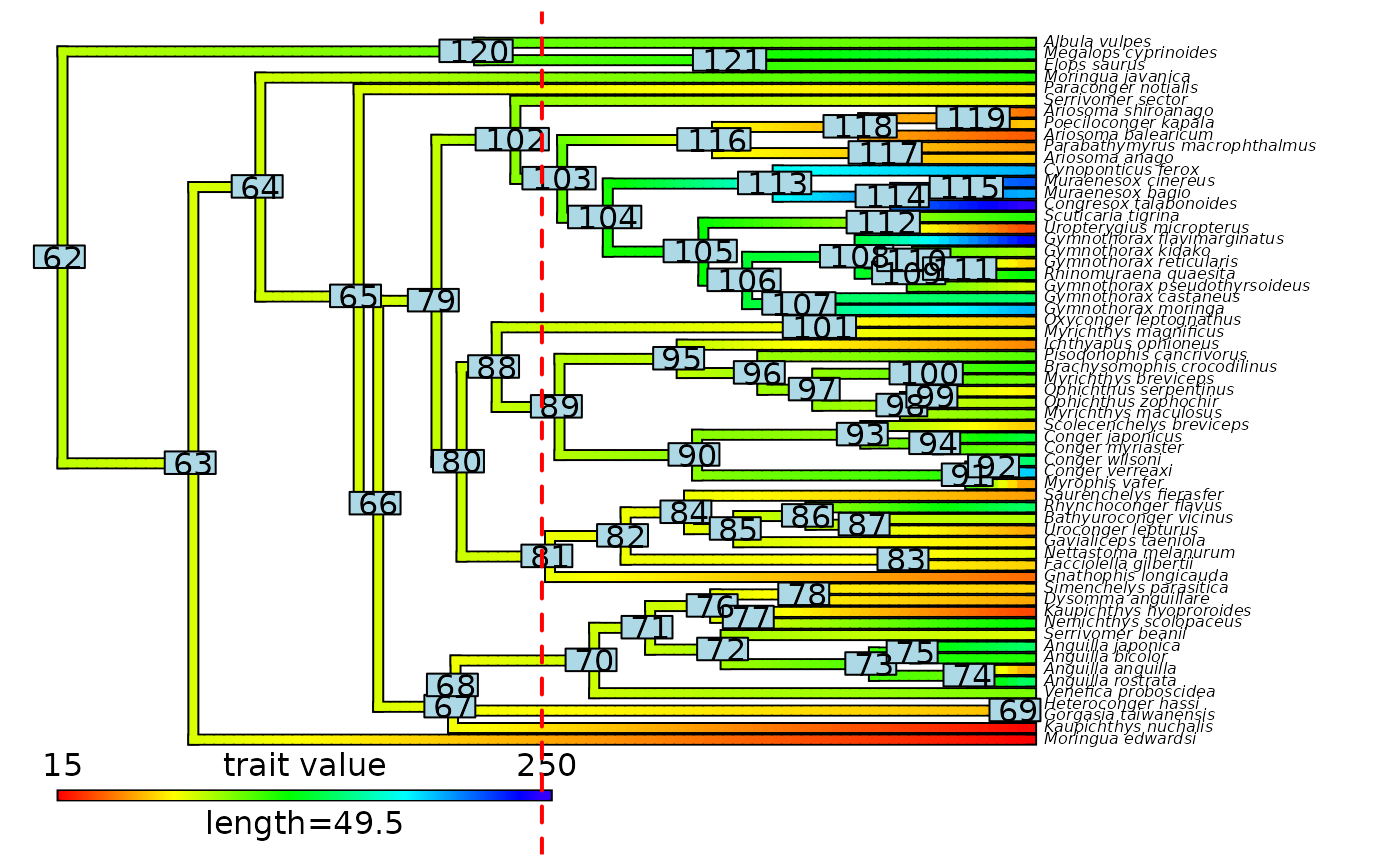
# Plot node labels on initial stochastic map with cut-off
plot(eel_contMap, fsize = c(0.5, 1))
ape::nodelabels()
abline(v = max(phytools::nodeHeights(eel_contMap$tree)[,2]) - focal_time,
col = "red", lty = 2, lwd = 2)
 # Plot updated contMap with initial node labels
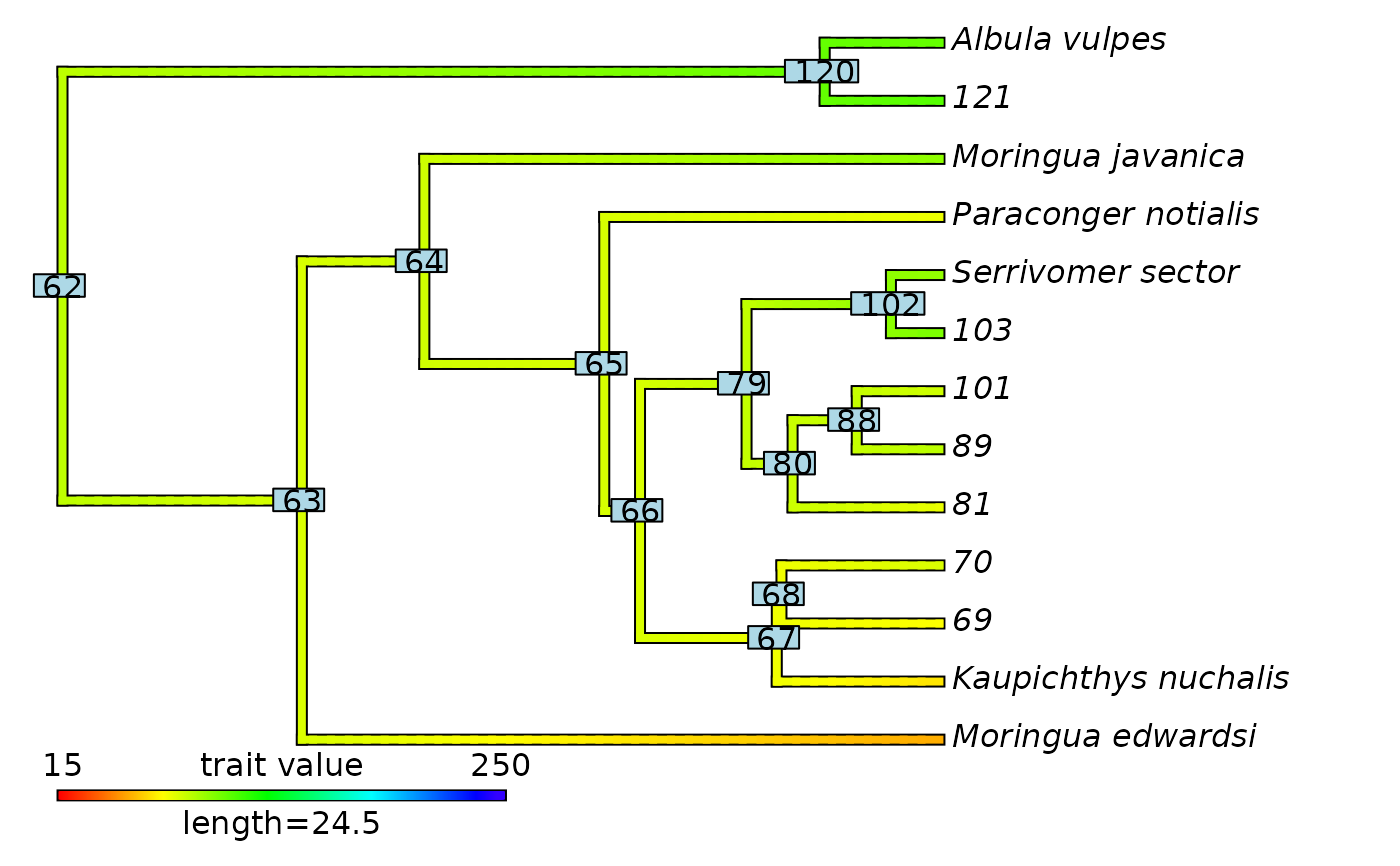
plot(eel_cont_50$contMap)
ape::nodelabels(text = eel_cont_50$contMap$tree$initial_nodes_ID)
# Plot updated contMap with initial node labels
plot(eel_cont_50$contMap)
ape::nodelabels(text = eel_cont_50$contMap$tree$initial_nodes_ID)
 # ----- Example 2: Categorical trait ----- #
# (May take several minutes to run)
## Load categorical trait data mapped on a phylogeny
data(eel_cat_3lvl_data, package = "deepSTRAPP")
# Explore data
str(eel_cat_3lvl_data, 1)
#> List of 6
#> $ densityMaps :List of 3
#> $ trait_data_type : chr "categorical"
#> $ simmaps :Class "multiPhylo"
#> List of 100
#> $ ace : num [1:60, 1:3] 0.26 0.3 0.39 0.43 0.43 0.44 0.43 0 0.47 0.49 ...
#> ..- attr(*, "dimnames")=List of 2
#> $ best_model_fit :List of 4
#> ..- attr(*, "class")= chr [1:2] "gfit" "list"
#> $ model_selection_df:'data.frame': 5 obs. of 6 variables:
eel_cat_3lvl_data$densityMaps # Three density maps: one per state
#> $Density_map_bite
#> Object of class "densityMap" containing:
#>
#> (1) A phylogenetic tree with 61 tips and 60 internal nodes.
#>
#> (2) The mapped posterior density of a discrete binary character
#> with states (Not bite, bite).
#>
#>
#> $Density_map_kiss
#> Object of class "densityMap" containing:
#>
#> (1) A phylogenetic tree with 61 tips and 60 internal nodes.
#>
#> (2) The mapped posterior density of a discrete binary character
#> with states (Not kiss, kiss).
#>
#>
#> $Density_map_suction
#> Object of class "densityMap" containing:
#>
#> (1) A phylogenetic tree with 61 tips and 60 internal nodes.
#>
#> (2) The mapped posterior density of a discrete binary character
#> with states (Not suction, suction).
#>
#>
# Set focal time to 10 Mya
focal_time <- 10
## Extract trait data and update densityMaps for the given focal_time
# Extract from the densityMaps
eel_cat_3lvl_data_10My <- extract_most_likely_trait_values_for_focal_time(
densityMaps = eel_cat_3lvl_data$densityMaps,
trait_data_type = "categorical",
focal_time = focal_time,
update_Map = TRUE)
#> WARNING: No ancestral character estimates (ace) for internal nodes have been provided. Using most likely states extracted from the densityMaps instead.
#> WARNING: No tip data have been provided. Using states extracted from the densityMaps instead.
## Print trait data
str(eel_cat_3lvl_data_10My, 1)
#> List of 4
#> $ trait_data : Named chr [1:52] "bite" "bite" "suction" "bite" ...
#> ..- attr(*, "names")= chr [1:52] "Moringua_edwardsi" "Kaupichthys_nuchalis" "69" "Venefica_proboscidea" ...
#> $ focal_time : num 10
#> $ trait_data_type: chr "categorical"
#> $ densityMaps :List of 3
eel_cat_3lvl_data_10My$trait_data
#> Moringua_edwardsi Kaupichthys_nuchalis
#> "bite" "bite"
#> 69 Venefica_proboscidea
#> "suction" "bite"
#> 74 Anguilla_bicolor
#> "suction" "suction"
#> Anguilla_japonica Serrivomer_beanii
#> "suction" "bite"
#> Nemichthys_scolopaceus Kaupichthys_hyoproroides
#> "bite" "bite"
#> Dysomma_anguillare Simenchelys_parasitica
#> "kiss" "kiss"
#> Gnathophis_longicauda Facciolella_gilbertii
#> "suction" "bite"
#> Nettastoma_melanurum Gavialiceps_taeniola
#> "bite" "bite"
#> Uroconger_lepturus Bathyuroconger_vicinus
#> "suction" "bite"
#> Rhynchoconger_flavus Saurenchelys_fierasfer
#> "kiss" "kiss"
#> 91 94
#> "suction" "suction"
#> Scolecenchelys_breviceps Myrichthys_maculosus
#> "suction" "suction"
#> 99 Myrichthys_breviceps
#> "suction" "suction"
#> Brachysomophis_crocodilinus Pisodonophis_cancrivorus
#> "suction" "bite"
#> Ichthyapus_ophioneus Myrichthys_magnificus
#> "kiss" "suction"
#> Oxyconger_leptognathus Gymnothorax_moringa
#> "bite" "bite"
#> Gymnothorax_castaneus Gymnothorax_pseudothyrsoideus
#> "bite" "kiss"
#> 111 Gymnothorax_kidako
#> "kiss" "kiss"
#> Gymnothorax_flavimarginatus Uropterygius_micropterus
#> "kiss" "kiss"
#> Scuticaria_tigrina Congresox_talabonoides
#> "kiss" "kiss"
#> 115 Cynoponticus_ferox
#> "bite" "kiss"
#> Ariosoma_anago Parabathymyrus_macrophthalmus
#> "kiss" "suction"
#> Ariosoma_balearicum 119
#> "kiss" "suction"
#> Serrivomer_sector Paraconger_notialis
#> "bite" "suction"
#> Moringua_javanica Elops_saurus
#> "bite" "suction"
#> Megalops_cyprinoides Albula_vulpes
#> "suction" "kiss"
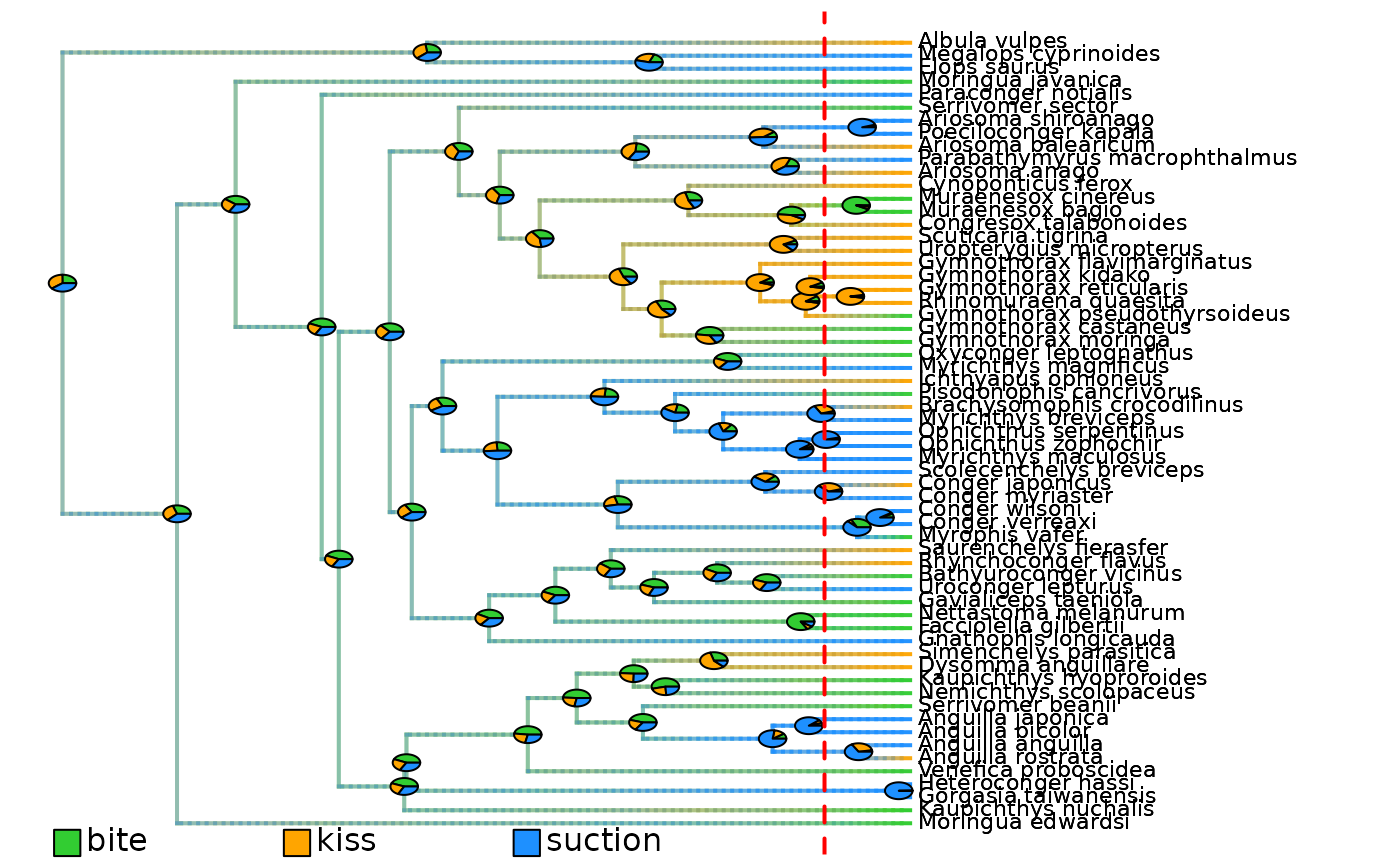
## Plot density maps as overlay of all state posterior probabilities
# Plot initial density maps with ACE pies
plot_densityMaps_overlay(densityMaps = eel_cat_3lvl_data$densityMaps)
abline(v = max(phytools::nodeHeights(eel_cat_3lvl_data$densityMaps[[1]]$tree)[,2]) - focal_time,
col = "red", lty = 2, lwd = 2)
# ----- Example 2: Categorical trait ----- #
# (May take several minutes to run)
## Load categorical trait data mapped on a phylogeny
data(eel_cat_3lvl_data, package = "deepSTRAPP")
# Explore data
str(eel_cat_3lvl_data, 1)
#> List of 6
#> $ densityMaps :List of 3
#> $ trait_data_type : chr "categorical"
#> $ simmaps :Class "multiPhylo"
#> List of 100
#> $ ace : num [1:60, 1:3] 0.26 0.3 0.39 0.43 0.43 0.44 0.43 0 0.47 0.49 ...
#> ..- attr(*, "dimnames")=List of 2
#> $ best_model_fit :List of 4
#> ..- attr(*, "class")= chr [1:2] "gfit" "list"
#> $ model_selection_df:'data.frame': 5 obs. of 6 variables:
eel_cat_3lvl_data$densityMaps # Three density maps: one per state
#> $Density_map_bite
#> Object of class "densityMap" containing:
#>
#> (1) A phylogenetic tree with 61 tips and 60 internal nodes.
#>
#> (2) The mapped posterior density of a discrete binary character
#> with states (Not bite, bite).
#>
#>
#> $Density_map_kiss
#> Object of class "densityMap" containing:
#>
#> (1) A phylogenetic tree with 61 tips and 60 internal nodes.
#>
#> (2) The mapped posterior density of a discrete binary character
#> with states (Not kiss, kiss).
#>
#>
#> $Density_map_suction
#> Object of class "densityMap" containing:
#>
#> (1) A phylogenetic tree with 61 tips and 60 internal nodes.
#>
#> (2) The mapped posterior density of a discrete binary character
#> with states (Not suction, suction).
#>
#>
# Set focal time to 10 Mya
focal_time <- 10
## Extract trait data and update densityMaps for the given focal_time
# Extract from the densityMaps
eel_cat_3lvl_data_10My <- extract_most_likely_trait_values_for_focal_time(
densityMaps = eel_cat_3lvl_data$densityMaps,
trait_data_type = "categorical",
focal_time = focal_time,
update_Map = TRUE)
#> WARNING: No ancestral character estimates (ace) for internal nodes have been provided. Using most likely states extracted from the densityMaps instead.
#> WARNING: No tip data have been provided. Using states extracted from the densityMaps instead.
## Print trait data
str(eel_cat_3lvl_data_10My, 1)
#> List of 4
#> $ trait_data : Named chr [1:52] "bite" "bite" "suction" "bite" ...
#> ..- attr(*, "names")= chr [1:52] "Moringua_edwardsi" "Kaupichthys_nuchalis" "69" "Venefica_proboscidea" ...
#> $ focal_time : num 10
#> $ trait_data_type: chr "categorical"
#> $ densityMaps :List of 3
eel_cat_3lvl_data_10My$trait_data
#> Moringua_edwardsi Kaupichthys_nuchalis
#> "bite" "bite"
#> 69 Venefica_proboscidea
#> "suction" "bite"
#> 74 Anguilla_bicolor
#> "suction" "suction"
#> Anguilla_japonica Serrivomer_beanii
#> "suction" "bite"
#> Nemichthys_scolopaceus Kaupichthys_hyoproroides
#> "bite" "bite"
#> Dysomma_anguillare Simenchelys_parasitica
#> "kiss" "kiss"
#> Gnathophis_longicauda Facciolella_gilbertii
#> "suction" "bite"
#> Nettastoma_melanurum Gavialiceps_taeniola
#> "bite" "bite"
#> Uroconger_lepturus Bathyuroconger_vicinus
#> "suction" "bite"
#> Rhynchoconger_flavus Saurenchelys_fierasfer
#> "kiss" "kiss"
#> 91 94
#> "suction" "suction"
#> Scolecenchelys_breviceps Myrichthys_maculosus
#> "suction" "suction"
#> 99 Myrichthys_breviceps
#> "suction" "suction"
#> Brachysomophis_crocodilinus Pisodonophis_cancrivorus
#> "suction" "bite"
#> Ichthyapus_ophioneus Myrichthys_magnificus
#> "kiss" "suction"
#> Oxyconger_leptognathus Gymnothorax_moringa
#> "bite" "bite"
#> Gymnothorax_castaneus Gymnothorax_pseudothyrsoideus
#> "bite" "kiss"
#> 111 Gymnothorax_kidako
#> "kiss" "kiss"
#> Gymnothorax_flavimarginatus Uropterygius_micropterus
#> "kiss" "kiss"
#> Scuticaria_tigrina Congresox_talabonoides
#> "kiss" "kiss"
#> 115 Cynoponticus_ferox
#> "bite" "kiss"
#> Ariosoma_anago Parabathymyrus_macrophthalmus
#> "kiss" "suction"
#> Ariosoma_balearicum 119
#> "kiss" "suction"
#> Serrivomer_sector Paraconger_notialis
#> "bite" "suction"
#> Moringua_javanica Elops_saurus
#> "bite" "suction"
#> Megalops_cyprinoides Albula_vulpes
#> "suction" "kiss"
## Plot density maps as overlay of all state posterior probabilities
# Plot initial density maps with ACE pies
plot_densityMaps_overlay(densityMaps = eel_cat_3lvl_data$densityMaps)
abline(v = max(phytools::nodeHeights(eel_cat_3lvl_data$densityMaps[[1]]$tree)[,2]) - focal_time,
col = "red", lty = 2, lwd = 2)
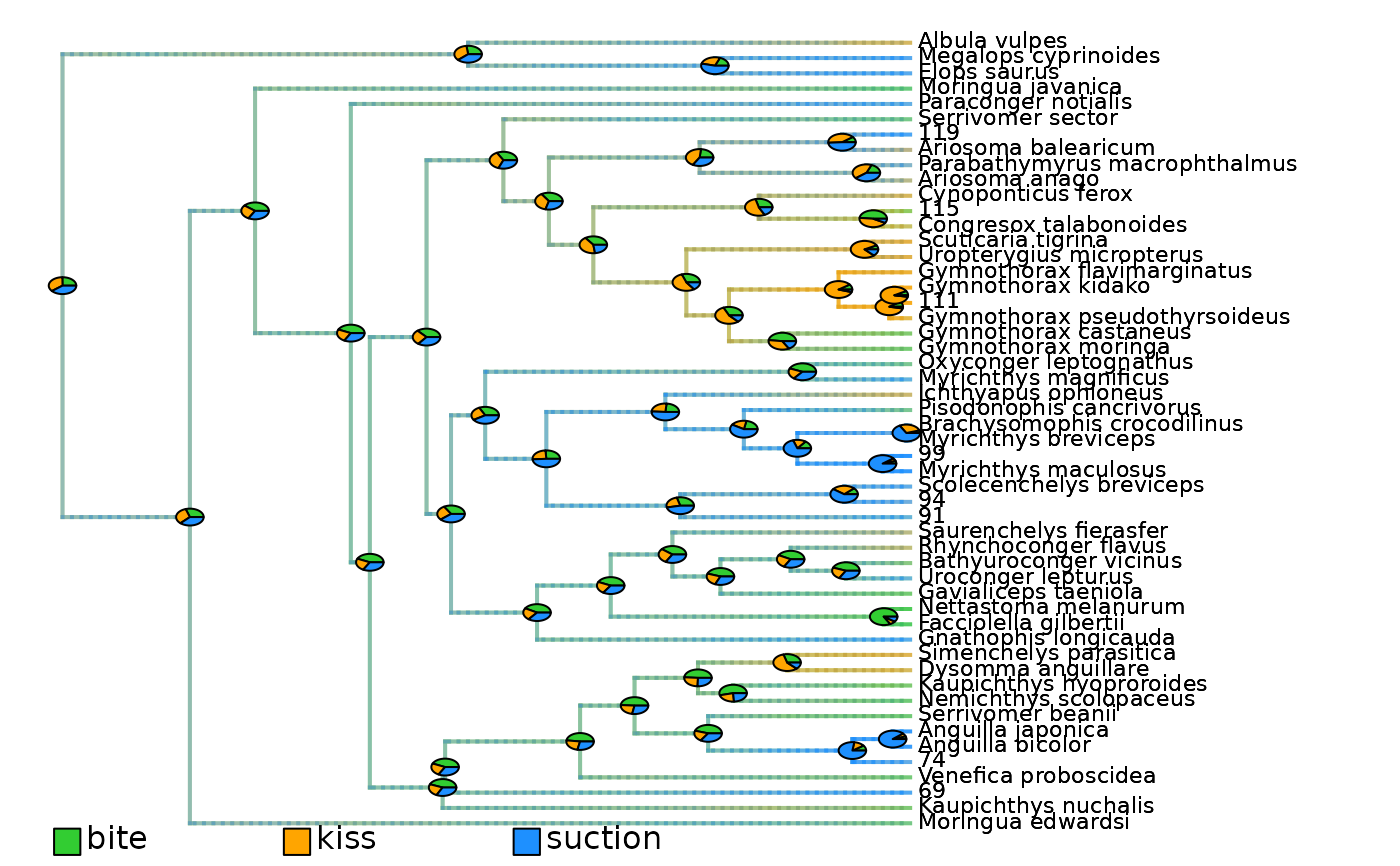
 # Plot updated densityMaps with ACE pies
plot_densityMaps_overlay(eel_cat_3lvl_data_10My$densityMaps)
# Plot updated densityMaps with ACE pies
plot_densityMaps_overlay(eel_cat_3lvl_data_10My$densityMaps)
 # ----- Example 3: Biogeographic ranges ----- #
# (May take several minutes to run)
## Load biogeographic range data mapped on a phylogeny
data(eel_biogeo_data, package = "deepSTRAPP")
# Explore data
str(eel_biogeo_data, 1)
#> List of 9
#> $ densityMaps :List of 2
#> $ densityMaps_all_ranges:List of 3
#> $ trait_data_type : chr "biogeographic"
#> $ ace : num [1:60, 1:2] 0.361 0.524 0.623 0.334 0.47 ...
#> ..- attr(*, "dimnames")=List of 2
#> $ ace_all_ranges : num [1:60, 1:3] 0.174 0.373 0.53 0.244 0.411 ...
#> ..- attr(*, "dimnames")=List of 2
#> $ BSM_output :List of 2
#> $ simmaps :Class "multiPhylo"
#> List of 100
#> $ best_model_fit :List of 13
#> $ model_selection_df :'data.frame': 6 obs. of 8 variables:
eel_biogeo_data$densityMaps # Two density maps: one per unique area: A, B.
#> $Density_map_A
#> Object of class "densityMap" containing:
#>
#> (1) A phylogenetic tree with 61 tips and 60 internal nodes.
#>
#> (2) The mapped posterior density of a discrete binary character
#> with states (Not A, A).
#>
#>
#> $Density_map_B
#> Object of class "densityMap" containing:
#>
#> (1) A phylogenetic tree with 61 tips and 60 internal nodes.
#>
#> (2) The mapped posterior density of a discrete binary character
#> with states (Not B, B).
#>
#>
eel_biogeo_data$densityMaps_all_ranges # Three density maps: one per range: A, B, and AB.
#> $Density_map_A
#> Object of class "densityMap" containing:
#>
#> (1) A phylogenetic tree with 61 tips and 60 internal nodes.
#>
#> (2) The mapped posterior density of a discrete binary character
#> with states (Not A, A).
#>
#>
#> $Density_map_B
#> Object of class "densityMap" containing:
#>
#> (1) A phylogenetic tree with 61 tips and 60 internal nodes.
#>
#> (2) The mapped posterior density of a discrete binary character
#> with states (Not B, B).
#>
#>
#> $Density_map_AB
#> Object of class "densityMap" containing:
#>
#> (1) A phylogenetic tree with 61 tips and 60 internal nodes.
#>
#> (2) The mapped posterior density of a discrete binary character
#> with states (Not AB, AB).
#>
#>
# Set focal time to 10 Mya
focal_time <- 10
## Extract trait data and update densityMaps for the given focal_time
# Extract from the densityMaps
eel_biogeo_data_10My <- extract_most_likely_trait_values_for_focal_time(
densityMaps = eel_biogeo_data$densityMaps,
# ace = eel_biogeo_data$ace,
trait_data_type = "biogeographic",
focal_time = focal_time,
update_Map = TRUE)
#> WARNING: No ancestral character estimates (ace) for internal nodes have been provided. Using most likely ranges extracted from the densityMaps instead.
#> WARNING: No tip data have been provided. Using ranges extracted from the densityMaps instead.
## Print trait data
str(eel_biogeo_data_10My, 1)
#> List of 4
#> $ trait_data : Named chr [1:52] "B" "B" "B" "A" ...
#> ..- attr(*, "names")= chr [1:52] "Moringua_edwardsi" "Kaupichthys_nuchalis" "69" "Venefica_proboscidea" ...
#> $ focal_time : num 10
#> $ trait_data_type: chr "biogeographic"
#> $ densityMaps :List of 2
eel_biogeo_data_10My$trait_data
#> Moringua_edwardsi Kaupichthys_nuchalis
#> "B" "B"
#> 69 Venefica_proboscidea
#> "B" "A"
#> 74 Anguilla_bicolor
#> "B" "B"
#> Anguilla_japonica Serrivomer_beanii
#> "B" "A"
#> Nemichthys_scolopaceus Kaupichthys_hyoproroides
#> "A" "A"
#> Dysomma_anguillare Simenchelys_parasitica
#> "A" "A"
#> Gnathophis_longicauda Facciolella_gilbertii
#> "B" "A"
#> Nettastoma_melanurum Gavialiceps_taeniola
#> "A" "A"
#> Uroconger_lepturus Bathyuroconger_vicinus
#> "A" "A"
#> Rhynchoconger_flavus Saurenchelys_fierasfer
#> "A" "A"
#> 91 94
#> "B" "B"
#> Scolecenchelys_breviceps Myrichthys_maculosus
#> "B" "B"
#> 99 Myrichthys_breviceps
#> "B" "B"
#> Brachysomophis_crocodilinus Pisodonophis_cancrivorus
#> "A" "A"
#> Ichthyapus_ophioneus Myrichthys_magnificus
#> "A" "B"
#> Oxyconger_leptognathus Gymnothorax_moringa
#> "A" "A"
#> Gymnothorax_castaneus Gymnothorax_pseudothyrsoideus
#> "A" "A"
#> 111 Gymnothorax_kidako
#> "A" "A"
#> Gymnothorax_flavimarginatus Uropterygius_micropterus
#> "A" "A"
#> Scuticaria_tigrina Congresox_talabonoides
#> "A" "A"
#> 115 Cynoponticus_ferox
#> "A" "A"
#> Ariosoma_anago Parabathymyrus_macrophthalmus
#> "B" "B"
#> Ariosoma_balearicum 119
#> "B" "B"
#> Serrivomer_sector Paraconger_notialis
#> "B" "B"
#> Moringua_javanica Elops_saurus
#> "A" "B"
#> Megalops_cyprinoides Albula_vulpes
#> "B" "B"
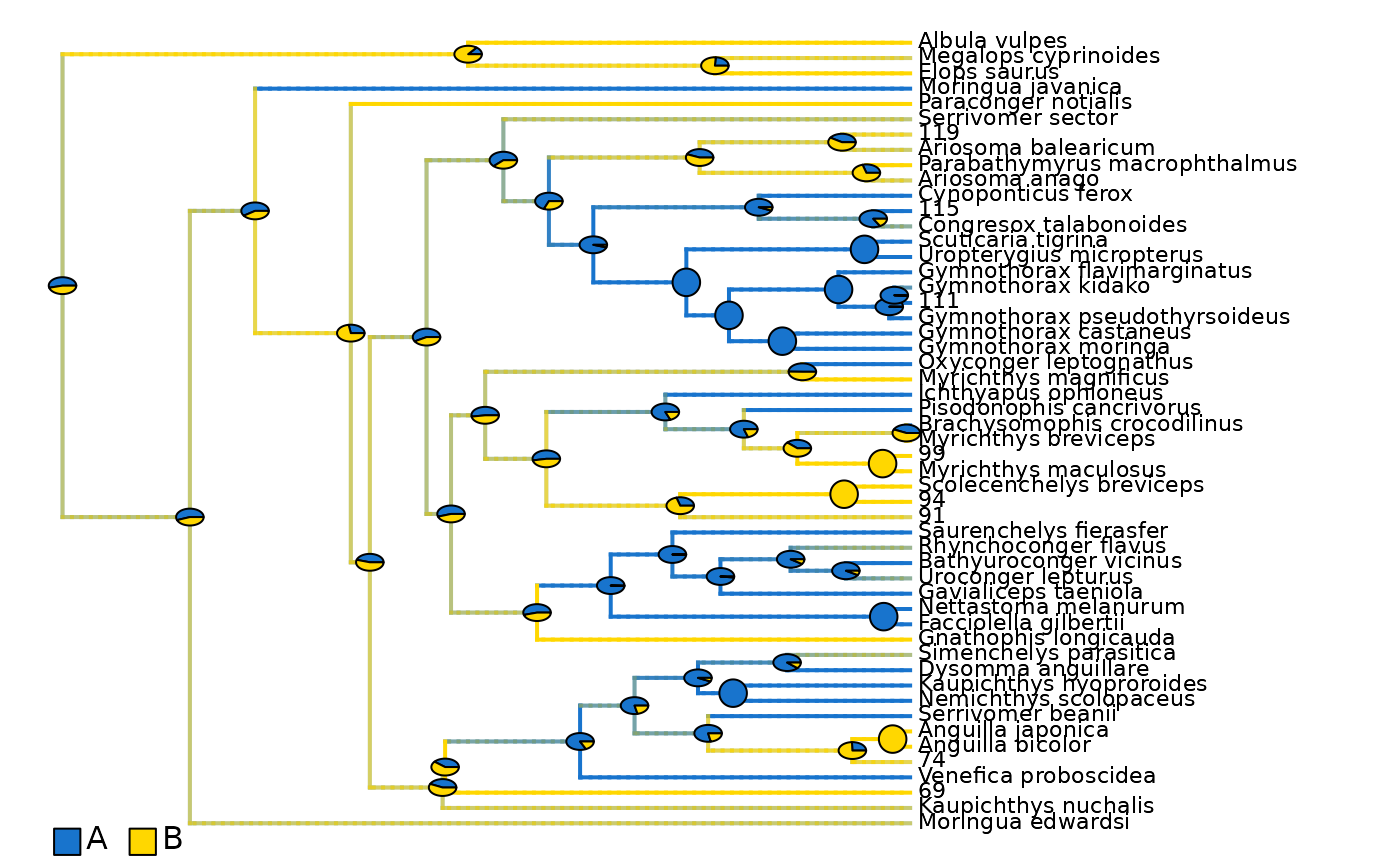
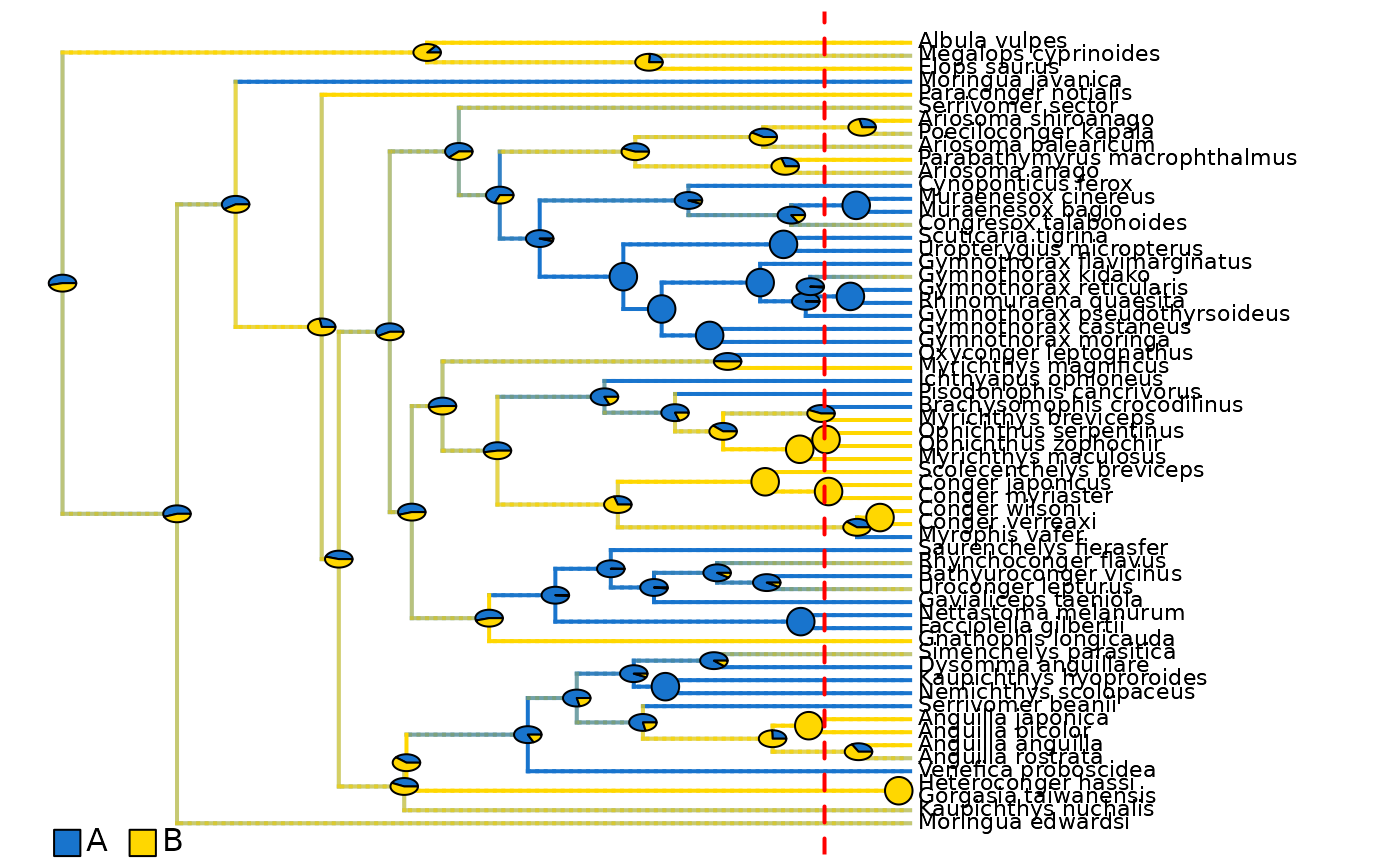
## Plot density maps as overlay of all range posterior probabilities
# Plot initial density maps with ACE pies
plot_densityMaps_overlay(densityMaps = eel_biogeo_data$densityMaps)
abline(v = max(phytools::nodeHeights(eel_biogeo_data$densityMaps[[1]]$tree)[,2]) - focal_time,
col = "red", lty = 2, lwd = 2)
# ----- Example 3: Biogeographic ranges ----- #
# (May take several minutes to run)
## Load biogeographic range data mapped on a phylogeny
data(eel_biogeo_data, package = "deepSTRAPP")
# Explore data
str(eel_biogeo_data, 1)
#> List of 9
#> $ densityMaps :List of 2
#> $ densityMaps_all_ranges:List of 3
#> $ trait_data_type : chr "biogeographic"
#> $ ace : num [1:60, 1:2] 0.361 0.524 0.623 0.334 0.47 ...
#> ..- attr(*, "dimnames")=List of 2
#> $ ace_all_ranges : num [1:60, 1:3] 0.174 0.373 0.53 0.244 0.411 ...
#> ..- attr(*, "dimnames")=List of 2
#> $ BSM_output :List of 2
#> $ simmaps :Class "multiPhylo"
#> List of 100
#> $ best_model_fit :List of 13
#> $ model_selection_df :'data.frame': 6 obs. of 8 variables:
eel_biogeo_data$densityMaps # Two density maps: one per unique area: A, B.
#> $Density_map_A
#> Object of class "densityMap" containing:
#>
#> (1) A phylogenetic tree with 61 tips and 60 internal nodes.
#>
#> (2) The mapped posterior density of a discrete binary character
#> with states (Not A, A).
#>
#>
#> $Density_map_B
#> Object of class "densityMap" containing:
#>
#> (1) A phylogenetic tree with 61 tips and 60 internal nodes.
#>
#> (2) The mapped posterior density of a discrete binary character
#> with states (Not B, B).
#>
#>
eel_biogeo_data$densityMaps_all_ranges # Three density maps: one per range: A, B, and AB.
#> $Density_map_A
#> Object of class "densityMap" containing:
#>
#> (1) A phylogenetic tree with 61 tips and 60 internal nodes.
#>
#> (2) The mapped posterior density of a discrete binary character
#> with states (Not A, A).
#>
#>
#> $Density_map_B
#> Object of class "densityMap" containing:
#>
#> (1) A phylogenetic tree with 61 tips and 60 internal nodes.
#>
#> (2) The mapped posterior density of a discrete binary character
#> with states (Not B, B).
#>
#>
#> $Density_map_AB
#> Object of class "densityMap" containing:
#>
#> (1) A phylogenetic tree with 61 tips and 60 internal nodes.
#>
#> (2) The mapped posterior density of a discrete binary character
#> with states (Not AB, AB).
#>
#>
# Set focal time to 10 Mya
focal_time <- 10
## Extract trait data and update densityMaps for the given focal_time
# Extract from the densityMaps
eel_biogeo_data_10My <- extract_most_likely_trait_values_for_focal_time(
densityMaps = eel_biogeo_data$densityMaps,
# ace = eel_biogeo_data$ace,
trait_data_type = "biogeographic",
focal_time = focal_time,
update_Map = TRUE)
#> WARNING: No ancestral character estimates (ace) for internal nodes have been provided. Using most likely ranges extracted from the densityMaps instead.
#> WARNING: No tip data have been provided. Using ranges extracted from the densityMaps instead.
## Print trait data
str(eel_biogeo_data_10My, 1)
#> List of 4
#> $ trait_data : Named chr [1:52] "B" "B" "B" "A" ...
#> ..- attr(*, "names")= chr [1:52] "Moringua_edwardsi" "Kaupichthys_nuchalis" "69" "Venefica_proboscidea" ...
#> $ focal_time : num 10
#> $ trait_data_type: chr "biogeographic"
#> $ densityMaps :List of 2
eel_biogeo_data_10My$trait_data
#> Moringua_edwardsi Kaupichthys_nuchalis
#> "B" "B"
#> 69 Venefica_proboscidea
#> "B" "A"
#> 74 Anguilla_bicolor
#> "B" "B"
#> Anguilla_japonica Serrivomer_beanii
#> "B" "A"
#> Nemichthys_scolopaceus Kaupichthys_hyoproroides
#> "A" "A"
#> Dysomma_anguillare Simenchelys_parasitica
#> "A" "A"
#> Gnathophis_longicauda Facciolella_gilbertii
#> "B" "A"
#> Nettastoma_melanurum Gavialiceps_taeniola
#> "A" "A"
#> Uroconger_lepturus Bathyuroconger_vicinus
#> "A" "A"
#> Rhynchoconger_flavus Saurenchelys_fierasfer
#> "A" "A"
#> 91 94
#> "B" "B"
#> Scolecenchelys_breviceps Myrichthys_maculosus
#> "B" "B"
#> 99 Myrichthys_breviceps
#> "B" "B"
#> Brachysomophis_crocodilinus Pisodonophis_cancrivorus
#> "A" "A"
#> Ichthyapus_ophioneus Myrichthys_magnificus
#> "A" "B"
#> Oxyconger_leptognathus Gymnothorax_moringa
#> "A" "A"
#> Gymnothorax_castaneus Gymnothorax_pseudothyrsoideus
#> "A" "A"
#> 111 Gymnothorax_kidako
#> "A" "A"
#> Gymnothorax_flavimarginatus Uropterygius_micropterus
#> "A" "A"
#> Scuticaria_tigrina Congresox_talabonoides
#> "A" "A"
#> 115 Cynoponticus_ferox
#> "A" "A"
#> Ariosoma_anago Parabathymyrus_macrophthalmus
#> "B" "B"
#> Ariosoma_balearicum 119
#> "B" "B"
#> Serrivomer_sector Paraconger_notialis
#> "B" "B"
#> Moringua_javanica Elops_saurus
#> "A" "B"
#> Megalops_cyprinoides Albula_vulpes
#> "B" "B"
## Plot density maps as overlay of all range posterior probabilities
# Plot initial density maps with ACE pies
plot_densityMaps_overlay(densityMaps = eel_biogeo_data$densityMaps)
abline(v = max(phytools::nodeHeights(eel_biogeo_data$densityMaps[[1]]$tree)[,2]) - focal_time,
col = "red", lty = 2, lwd = 2)
 # Plot updated densityMaps with ACE pies
plot_densityMaps_overlay(eel_biogeo_data_10My$densityMaps)
# Plot updated densityMaps with ACE pies
plot_densityMaps_overlay(eel_biogeo_data_10My$densityMaps)